
Detecting dark matter, one of the major unsolved problems in physics, has long attracted the attention of the scientific community. Recently, a research team from Tohoku University in Japan published a new study in Physical Review D, proposing a method to improve the sensitivity of dark matter detection by constructing quantum sensor networks. These quantum sensors, relying on the rules of quantum physics, can capture extremely weak signals left by dark matter, with sensitivity far exceeding that of conventional sensors.
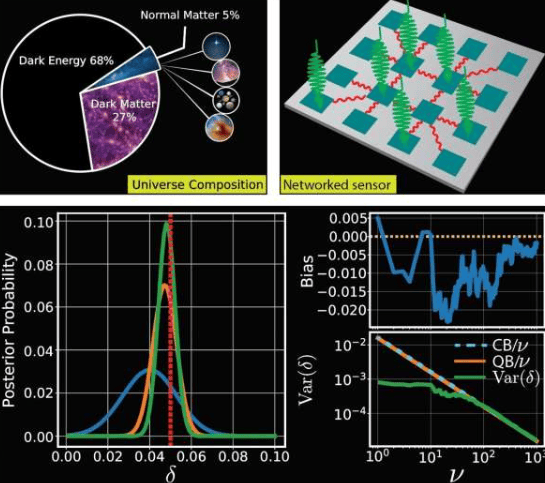
The study focuses on superconducting qubits — miniature circuits cooled to extremely low temperatures, typically used as building blocks for quantum computers. In this research, they are transformed into powerful quantum sensors. By connecting multiple superconducting qubits into an optimized network, the team found that this combination can detect dark matter signals more effectively, with performance far superior to that of a single sensor.
To verify this discovery, the research team tested different network configurations for four-qubit and nine-qubit systems, including ring, linear, star, and fully connected graphs. They employed variational quantum metrology methods to optimize the preparation and measurement of quantum states, while using Bayesian estimation to filter out noise and improve detection accuracy. The results show that even when realistic noise is introduced, the optimized quantum network still outperforms traditional methods, proving that the approach is also effective on current quantum devices.
"Our goal is to optimize the organization and fine-tuning of quantum sensors to detect dark matter more reliably," said Dr. Le Bin Ho, the lead author of the study. "The network structure is crucial for improving sensitivity, and we have demonstrated that this can be achieved using relatively simple circuits." In addition, these quantum sensor networks are not limited to dark matter detection; they can also drive technological development in fields such as quantum radar, gravitational wave detection, and ultra-precise timing. In the future, they may improve GPS accuracy, enhance nuclear magnetic resonance brain imaging, and even help detect hidden underground structures.