
Researchers at Oak Ridge National Laboratory (ORNL) of the U.S. Department of Energy are breaking through technical barriers by developing faster circuit breakers to support and protect the modern power grid. The medium-voltage circuit breakers developed by the ORNL team can handle higher levels of direct current (DC) at lower costs. This advancement helps reduce future electricity costs and expand the capacity of the overburdened U.S. power grid.
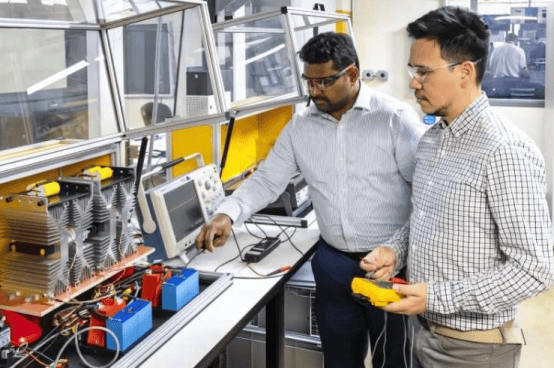
Lead researcher Prasad Kandula said: "The lack of DC medium-voltage circuit breakers has been a major obstacle to power delivery flexibility. Developing this technology helps ensure the grid operates safely and reliably while providing more energy supply to support our growing population and economy."
Circuit breakers are a long-standing safety device in the power grid. They automatically interrupt current when it exceeds expected values or when a system fault causes current to flow along unintended paths. For example, if a wire is grounded, a mechanical circuit breaker or fuse can cut off the current, thereby reducing the risk of fire or power outage.
Traditional circuit breakers are designed for alternating current (AC), the type of current that flows through most of the grid and into buildings. AC is easy to interrupt because it changes direction 60 times per second. However, direct current (DC) flows in only one direction.
"Once you use DC, the 'zero current' moment disappears — without it, mechanical switches cannot quickly stop a fault, preventing heat buildup and potential fires," said Kandula, leader of ORNL's Grid Systems Hardware Group.
To solve this problem, ORNL researchers are designing and scaling up a new type of semiconductor circuit breaker that operates up to 100 times faster than mechanical switches. This makes DC more viable for use in the power grid, as it is more attractive to energy system designers due to its efficiency, flexibility, and compatibility with modern energy sources and loads.
DC systems can provide more economical power for energy-intensive economic development projects such as artificial intelligence data centers. This is because DC experiences less resistance in transmission lines and incurs lower energy losses during transmission. When current does not need to be converted between DC power electronics and the AC grid, additional losses can be avoided.
Considering all these factors, DC systems waste less electricity overall, thereby increasing grid capacity and lowering energy costs while better supporting the multi-directional power flow of the modern grid.
Medium-voltage circuit breakers are critical for enabling DC distribution. DC systems rely on fast-responding power electronics, which in turn require equally fast protection. Semiconductor circuit breakers provide speed and higher safety for DC systems. Traditional mechanical circuit breakers rely on physical gaps, which are less effective at stopping DC because DC can easily create sparks across the gap in explosive arcs. To avoid the possibility of arcing, current can be steered through semiconductor-based devices, significantly reducing safety risks and wildfire hazards.
So far, semiconductor circuit breakers have been too expensive to economically compete with mechanical AC circuit breakers or to promote wider adoption of DC grids. Currently, no commercial circuit breaker can handle DC voltages above 2000 volts, and most cannot even reach half that figure.
Kandula and his team set out to find a cost-effective solution to bridge this performance gap. They focused on an older, industry-proven semiconductor — the thyristor. "We chose a robust, efficient, and inexpensive base technology," Kandula said. Thyristors are affordable enough to make semiconductor-based switches competitive for the first time.
Since thyristors cannot be turned off directly, the team also had to design an external circuit to force the current to drop. At ORNL's Grid Research Integration and Deployment Center (GRID-C), engineers built and tested a circuit breaker prototype that can interrupt 1400 volts in less than 50 microseconds — 4 to 6 times faster than previously demonstrated thyristor speeds. The research was published in the 2024 IEEE Energy Conversion Congress and Exposition (ECCE).
To demonstrate that the technology can be scaled to handle higher voltages, the researchers connected the circuit breakers in series — linking them one after another on the same circuit. This approach faces several technical challenges: first, the voltage must be evenly distributed across all breakers to prevent any single device from being overloaded and failing. Second, assembling series-connected breakers must not delay the system's fast response time.
ORNL researchers designed solutions and tested them in a series of circuit breakers up to 1800 volts. They are currently working to expand the series, ultimately aiming to increase the voltage to 10,000 volts to meet the greater energy demands of future DC grids.