
In the cutting-edge field where high-end equipment manufacturing meets construction technology, an innovative human-robot collaborative construction technique is transforming traditional wall-building methods. The Technical University of Munich (TUM), in collaboration with the Munich-Ebersberg Building Association, successfully tested this technology under real-world conditions, demonstrating how robots can work closely with craftsmen to precisely build climate-optimized walls.
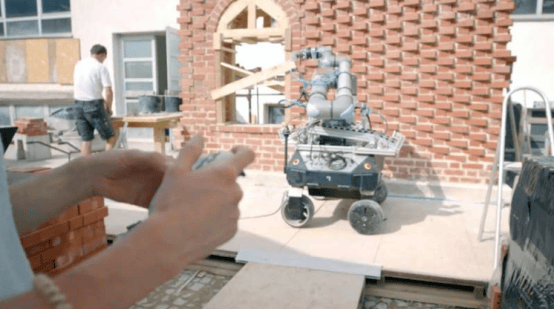
During the test, TUM researcher Julia Fleckenstein worked alongside apprentices from the building association to lay bricks, with a robot developed by TUM constantly assisting on site. The wall was carefully designed so that the placement angle of each brick was calculated according to a digital design configurator to adapt to the lighting conditions of the construction site, achieving climate optimization. Among the 1,700 bricks, more than 200 were rotated outward from the wall at different angles, showcasing the precision of the digital design.
The robot stores a digital twin model of the wall, and its assembly logic is directly integrated into the design process, becoming a "new colleague" for the craftsmen. The robotic arm is equipped with a gripper and mounted on a mobile base, allowing it to flexibly reach any position on the wall and provide precision beyond human limits. Bricklaying and plastering trainer Markus Bruckner said that the robot does not replace craftsmen but complements their skills, jointly improving construction quality.
Dragan Stanojevic, a bricklaying apprentice involved in the project, initially felt uncomfortable working side by side with the robot, but soon adapted to the new mode. He said it now seems easy to imagine. The project also adheres to the concept of simplified construction, using only bricks for masonry, demonstrating the sustainability and ease of disassembly and reuse of single-material construction.
A workshop jointly initiated by Professor Kathrin Dörfer of Digital Fabrication at TUM and master craftsman Laura Lammel of the Munich-Ebersberg Building Association clearly stated that collaborative robots aim to expand rather than replace traditional craftsmanship. The interaction between digital planning, robotic execution, and craftsmanship creates new possibilities for the construction process and opens future-oriented career prospects for trainees.
The successful test of this human-robot collaborative construction technology not only demonstrates the innovative application of high-end equipment manufacturing in the construction field, but also provides strong support for the digital transformation of traditional craftsmanship, signaling that the future construction industry will become more intelligent, efficient, and sustainable.