
A research team from Seoul National University of Science and Technology has developed a new tactile sensing platform that utilizes a three-dimensional auxetic mechanical metamaterial (AMM) structure manufactured through digital light processing 3D printing technology. The research results were published in the journal Advanced Functional Materials. The first author is Mingyu Kang, a master's student in the Department of Mechanical Design and Robot Engineering, and the study was supervised by Associate Professor Soonjae Pyo.
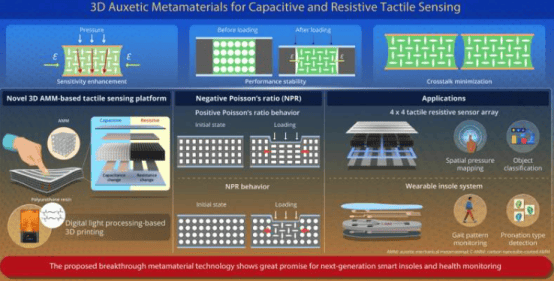
Tactile sensing technology is a key technology in the fields of robotics, wearable devices, and medical monitoring, capable of converting external pressure signals into electrical signals. Traditional sensors have room for improvement in sensing range and sensitivity, while auxetic metamaterials with negative Poisson's ratio exhibit inward contraction and strain concentration under pressure, providing a new pathway for enhancing sensor performance.
The cubic lattice structure designed by the research team contains spherical voids and supports two sensing modes: capacitive and piezoresistive. The capacitive mode detects pressure through changes in electrode spacing, while the piezoresistive mode uses resistance changes in a carbon nanotube coating under load to achieve sensing. Kang said: "Our technology utilizes the unique negative Poisson's ratio behavior, which causes inward contraction under compression, concentrating strain in the sensing area and improving sensitivity."
The sensor offers three main advantages: localized strain concentration that enhances sensitivity, stable performance maintained within an enclosed structure, and minimized crosstalk between sensing units. Compared with traditional porous structures, this design reduces lateral expansion and improves wear resistance and anti-interference capability during device integration. Dr. Pyo pointed out: "Even when confined within a rigid shell, the auxetic structure maintains its sensitivity and stability, whereas traditional porous lattices typically lose performance in such configurations."
The research team demonstrated two application scenarios: a tactile array for pressure mapping and object recognition, and a smart insole system capable of monitoring gait and analyzing foot pronation. The technology can also be applied to robotic hand manipulation and health monitoring systems. With the development of additive manufacturing technology, this programmable tactile interface is expected to find wide application in consumer products, healthcare, and robotics.