
Two physicists from the University of Stuttgart have achieved a groundbreaking discovery, proving that the Carnot principle — a core law of thermodynamics — no longer applies to correlated objects at the atomic scale. This finding is expected to advance the development of miniature energy-efficient quantum engines. The related derivations have been published in the journal Science Advances.
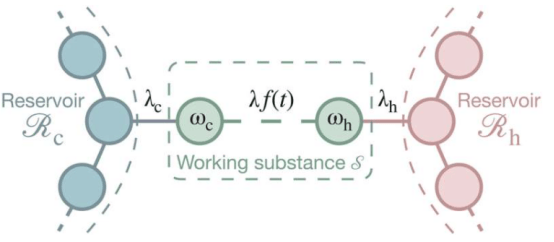
The study points out that the Carnot principle was originally proposed for large macroscopic objects and applies to traditional heat engines such as internal combustion engines and steam turbines. However, with the development of quantum mechanics experiments, the size of heat engines has been reduced to the microscopic scale. In this context, Professor Eric Lutz and Dr. Milton Aguilar from the Institute for Theoretical Physics I at the University of Stuttgart found that the Carnot principle does not account for the effects of quantum correlations. Quantum correlations are special bonds formed between particles at extremely small scales and play a critical role in the efficiency of heat engines.
Professor Lutz explained: "The traditional Carnot principle holds that the greater the temperature difference, the higher the maximum efficiency of a heat engine. However, our research derives a generalized thermodynamic law for the first time, proving that heat engines operating at the atomic scale can not only convert heat into work, but also convert correlations into work." This means that the efficiency of quantum engines can surpass the traditional Carnot limit. Dr. Aguilar further pointed out: "The Carnot principle must be extended to describe objects at the atomic scale, such as strongly correlated molecular motors."
This fundamental research not only deepens humanity's understanding of the world at the atomic level, but also opens up broad prospects for future technologies. Professor Lutz stated: "Understanding the physical laws at these scales will help develop future-oriented technologies, such as miniature high-efficiency quantum motors. Perhaps one day, these motors could drive medical nanorobots or machines that process materials at the atomic level."