
Using NASA's Transiting Exoplanet Survey Satellite (TESS), astronomers have discovered two rocky exoplanets orbiting a nearby K-type star (TOI-2322). The two newly discovered exoplanets are roughly the size of Earth and have relatively short orbital periods. A paper detailing the discovery was published on the arXiv preprint server on August 25.
TESS is conducting a survey of approximately 200,000 of the brightest stars near the Sun in search of transiting exoplanets. Since its launch in 2018, TESS has identified more than 7,600 candidate exoplanets (TESS Objects of Interest, or TOIs), of which 686 have been confirmed.
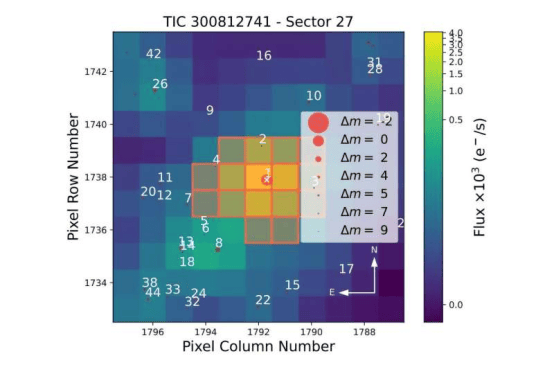
TOI-2322, also known as TIC 300812741, is a K4 spectral type star located approximately 195 light-years from Earth. Between 2018 and 2023, the TESS satellite observed this star multiple times. These observations revealed transit signals in its light curve, suggesting the presence of exoplanets. Follow-up observations by a team of astronomers led by Melissa Hobson of the University of Geneva in Switzerland recently confirmed the planetary nature of these signals.
The researchers wrote in the paper: "These planets were initially identified as candidates by the Transiting Exoplanet Survey Satellite mission. We used radial velocities and activity indicators from the Echelle Spectrograph for Rocky Exoplanets and Stable Spectroscopic Observations (ESPRESSO) to confirm and characterize these planets."
The newly discovered planet closer to TOI-2322 has been named TOI-2322 b. It is roughly Earth-sized, with an estimated mass of less than 2.03 Earth masses. The planet orbits its host star with a period of 11.3 days at a distance of approximately 0.09 astronomical units, and its equilibrium temperature is estimated at 603.1K.
The more distant and larger planet, TOI-2322 c, has a radius about 1.87 times that of Earth and a mass about 18 times that of Earth, with a density of 14.69g/cm³. The planet orbits its host star at approximately 0.13 astronomical units with an orbital period of 20.2 days and an equilibrium temperature close to 500 Kelvin.
The characteristics of TOI-2322 b and TOI-2322 c indicate that they are rocky short-period exoplanets. Astronomers noted that the internal structure of TOI-2322 c is very similar to that of Earth, making it one of the largest and most massive Earth-like planets known to date.
Its host star, TOI-2322, is about 30% smaller and less massive than the Sun. The star has an effective temperature of 4664 K and a metallicity of -0.12 dex. The age of TOI-2322 is estimated to be 3.9 billion years.
The paper's authors noted that TOI-2322 has a rotation period of 21.28 days, which is close to the orbital period of TOI-2322 c. This proximity may mask the presence of transiting planets. Therefore, the TOI-2322 system is an excellent laboratory for testing methods to separate planetary and activity signals in radial velocity measurements.