
An undergraduate team from the University of New Hampshire, Sonoma State University, and Howard University has jointly developed a CubeSat named "3UCubed," which is scheduled to launch on November 10, 2025, aboard a SpaceX rocket from Vandenberg Space Force Base in California. The satellite will work in coordination with NASA's Interstellar Mapping and Acceleration Probe (IMAP) mission to conduct research on solar wind and the upper atmosphere.
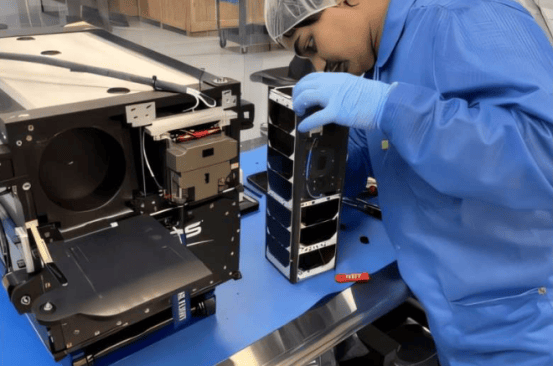
The CubeSat will enter Earth's thermosphere to measure atmospheric density and electron precipitation. The project team consists of 70 undergraduates and took five years to complete the satellite's design, development, and assembly. Noé Lugaz, Research Professor of Physics and Astronomy at the University of New Hampshire, said: "This is an excellent opportunity for students to gain hands-on technical experience and collaborate with other undergraduates from across the country to design and build an entire space mission. This experience is extremely valuable and can open doors to future career opportunities in aerospace or other scientific and engineering fields."
The two payload instruments carried by the satellite were manufactured and tested at the University of New Hampshire, where students led the instrument software development and collaborated with Sonoma State University on the flight software. Sonoma State University is responsible for building the mission's primary ground station and developing the data collection and command transmission system. Howard University participated in building the backup ground station to jointly ensure the satellite's on-orbit operations.
Alex Chesley, a 2022 mechanical engineering graduate, reflected on his participation: "At the time, I was very interested in the aerospace industry and saw this as a great opportunity to work with professionals in the field and gain valuable experience. It was fascinating to learn so much new knowledge about space science and instrumentation that I had never been exposed to before." Chesley was responsible for the initial satellite model design and now works in the aerospace industry.
Haley Joerger, a 2024 computer science graduate from Sonoma State University, said: "The SSU CubeSat project has had a profound impact on my personal and professional development. Participating in the CubeSat hardware project allowed me to gain valuable experience with instrumentation, a skill that has greatly benefited me now as an Application Engineer at Keysight Technologies."
The project provides a low-cost solution for space science research through the CubeSat platform while cultivating students' practical capabilities in aerospace engineering. The research data will be used to improve space weather forecasting models and help protect ground infrastructure such as communication networks and power grids.