
A joint research team from the Korea Advanced Institute of Science and Technology (KAIST) and LG Energy Solution has made new progress in the field of lithium metal battery technology. The team, led by Professor Hee-Tak Kim from the Department of Chemical and Biomolecular Engineering, published its research results recently in the journal Nature Energy.
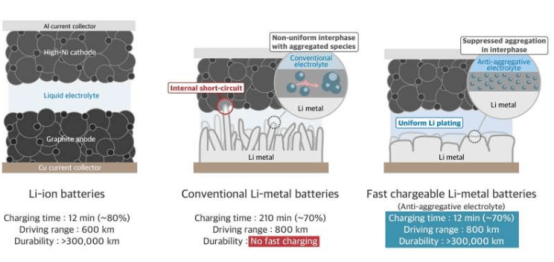
Lithium metal batteries are regarded as a potential power source for next-generation electric vehicles due to their high energy density. However, their application has long been constrained by the dendrite problem. Dendrites are tree-like crystals that form on the surface of the lithium metal anode during charge and discharge, potentially affecting battery safety and cycle life. The research team developed a new type of liquid electrolyte that can effectively suppress dendrite formation, thereby improving battery performance.
The electrolyte adopts a special anion structure that reduces the inhomogeneity of lithium ion binding and improves the stability of the electrode interface. Even under fast-charging conditions, it can control dendrite growth, enabling the battery to support a driving range of approximately 800 kilometers on a single charge, with a service life exceeding 300,000 kilometers, and a charging time shortened to 12 minutes.
Je-Young Kim, Chief Technology Officer of LG Energy Solution, said: "Through four years of continuous collaboration with KAIST at the Frontier Research Laboratory, we have achieved multiple results. In the future, we will continue to deepen industry-academia-research collaboration and work to solve technical challenges in next-generation battery technology."
Professor Hee-Tak Kim pointed out: "This study starts from the interfacial structure mechanism and provides a new path to address the technical challenges of lithium metal batteries, removing a major obstacle to their application in electric vehicles."
The research provides experimental basis and material strategies for the development of high energy density batteries, helping to promote the application of lithium metal batteries in the field of electric vehicles.