
Scientists using data from NASA's James Webb Space Telescope (JWST) have discovered a massive black hole that may have formed within the first few microseconds after the Big Bang. If confirmed, this discovery would provide the first evidence of the existence of primordial black holes predicted by Stephen Hawking in the 1970s. JWST observed a population of celestial objects known as "Little Red Dots" (LRDs), which are believed to be homes to young black holes — infant galaxies.
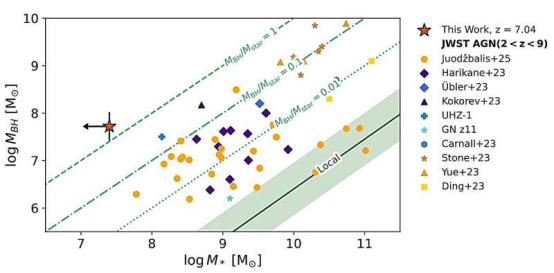
An international team led by Cambridge University astrophysicist Ignas Juodžbalis directly measured the mass of one of these LRDs. The results show that the red dot named QSO1 is a black hole with a mass equivalent to 50 million suns and is in the early stages of accretion, with its gravity actively pulling in surrounding gas and dust. What makes this discovery remarkable is that the black hole is almost naked, surrounded by only a small amount of material, which contradicts traditional black hole formation theories.
Traditional theory holds that galaxies form first, and supermassive black holes at their centers subsequently grow by consuming gas and stars. However, the galaxy surrounding the QSO1 black hole is much smaller than scientists expected, suggesting that these cosmic giants may have been born before their host galaxies were fully formed and grew at an astonishing rate. This implies that black holes may have participated in the formation of their host galaxies rather than merely being a result of it.
The researchers wrote in the paper: "This demonstrates the possibility of a black hole primacy effect, where black holes form and/or grow earlier and/or faster than their host galaxies." However, before scientists can rewrite cosmological theory, further research and analysis are still needed. By measuring the masses of other LRDs and distant supermassive black holes, scientists will gain a clearer understanding of the formation mechanisms of the earliest black holes, thereby verifying whether the new theory is correct and how it fits into our overall framework of understanding the universe.