
With the development of quantum computer technology, the security of traditional communication systems is facing challenges. Quantum communication, as a solution, has its performance directly affected by the efficiency of its key component — the single-photon source. In traditional methods, the single-photon emitter is placed outside the optical fiber, and the photon must be guided into the fiber, resulting in high transmission loss. To improve efficiency, a research team led by Associate Professor Kaoru Sanaka from the Department of Physics at Tokyo University of Science has developed a high-efficiency fiber-coupled single-photon source that can directly generate single photons inside the optical fiber.
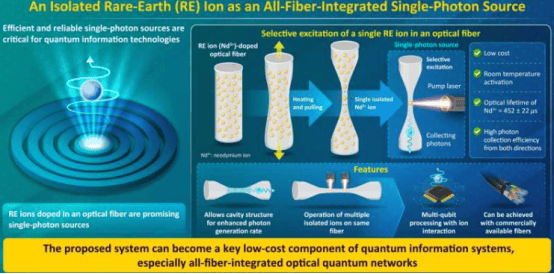
The team prepared a silica optical fiber doped with neodymium ions (Nd³⁺) and used a heat-drawing process to shape it into a tapered form, achieving selective excitation of individual Nd³⁺ ions. At room temperature, a pump laser is used to excite the ions, generating single photons that directly enter the fiber's guided mode. The researchers verified the generation and effective transmission of single photons through autocorrelation analysis and confirmed that changes in the fiber taper do not affect the optical properties of the ions. The new method significantly outperforms non-selective excitation methods in photon collection efficiency, with even higher efficiency when collected from both sides of the fiber.
Dr. Sanaka pointed out that this method is low-cost, offers selectable wavelengths, is easy to integrate into fiber communication networks, and operates at room temperature, making it a strong candidate for next-generation all-fiber integrated quantum communication networks. In addition, the method can also power quantum computing technology by operating multiple isolated ions within the same optical fiber to develop multi-qubit processing units and implement qubit encoding protocols.