
Los Alamos National Laboratory (LANL) is seeking commercial partners for its Plasma Liner Experiment (PLX), a platform designed to explore fusion energy and other high-energy plasma applications. Companies interested in collaborating on the development of this new technology must submit proposals by October 4, 2025. The laboratory expects to select partners by November 15, 2025.
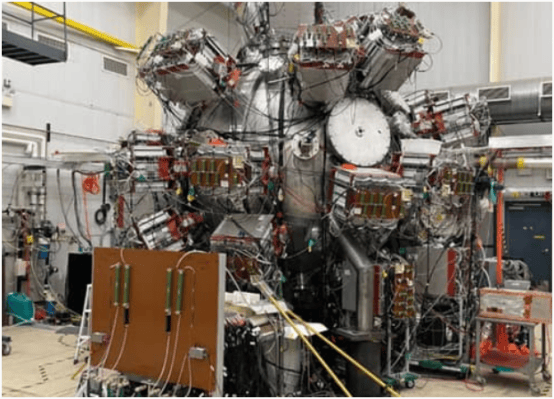
The PLX project is developing a new approach to achieving nuclear fusion. Its machine fires dozens of high-speed plasma jets toward a central point. These jets converge to form a collapsing plasma shell called a "liner," which rapidly compresses a magnetized target to generate the intense heat and pressure required for fusion — the same process that powers the Sun.
This method has clear advantages: it does not require the giant superconducting magnets or building-sized lasers common in other fusion experiments, making the PLX design a simpler, more economical, and more compact way to study and produce fusion energy.
In the short term (within the next one to three years), the technology can be used as a unique test facility capable of reproducing the extreme conditions faced by hypersonic vehicles and spacecraft during atmospheric re-entry. This will help companies test the durability of critical components in the aerospace and defense industries (such as advanced materials for heat shields). Currently, very few facilities are capable of conducting such tests.
The long-term goal of the project is to create new clean energy within the next decade, positioning PLX as a viable pathway to grid-scale fusion energy. With its modular and scalable design, it is expected to drive the development of smaller, more efficient power plants capable of producing abundant carbon-free electricity.
Project Principal Investigator Chuang Feng stated that the Plasma Liner Experiment represents a transformative step forward for fusion energy and national security applications. By using a modular, cost-effective platform that does not rely on large lasers or superconducting magnets, it opens the door to affordable and scalable solutions.
In addition, researchers at Los Alamos National Laboratory have been actively studying nuclear fusion technology. A team led by the laboratory, in collaboration with Lawrence Livermore National Laboratory (LLNL), successfully achieved fusion ignition in an experiment using a new diagnostic platform. This experiment marked the first operational test of the laboratory's Thinned Hohlraum Optimization (THOR) window system, producing 2.4 ± 0.09 megajoules of fusion energy and forming a "burning plasma" self-sustaining feedback loop. As early as 2024, scientists at the laboratory had proposed implementing "tungsten shotgun" technology to enhance the stability of fusion reactors. The injected tungsten particles can effectively collide with runaway electrons, absorb their energy, and divert them from destructive trajectories.