
A joint study by the University of Oxford and the Southwest Research Institute has confirmed the existence of significant heat flow in the north polar region of Saturn's moon Enceladus, with heat loss far exceeding the expected level for a passive celestial body. The research, published in Science Advances, overturns the previous understanding that heat is concentrated only at the south pole and provides new evidence that this icy satellite may harbor habitable environments.
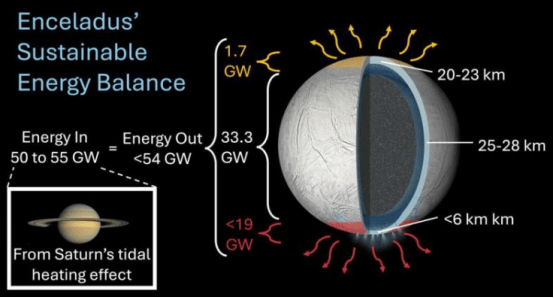
The research team used observational data from NASA's Cassini spacecraft in 2005 and 2015 to comparatively analyze surface temperatures in Enceladus' north polar region. By establishing a heat conduction model, the researchers found that the surface temperature in the north polar region is approximately 7 Kelvin higher than expected. Dr. Georgina Miles, first author of the paper, said: "Understanding the long-term availability of energy on Enceladus is key to determining whether it can support life." Measurements show that the north polar heat flow reaches 46 milliwatts per square meter, equivalent to two-thirds of the heat loss from Earth's continental crust.
Combining the known heat flow data from the south pole, the global total heat loss from Enceladus is 54 gigawatts, consistent with predictions from tidal heating theory. Dr. Carly Howett, corresponding author of the paper, pointed out: "This new result supports the long-term sustainability of Enceladus, which is crucial for the development of life." The study also estimated the thickness of the north polar ice shell to be 20 to 23 kilometers, slightly thinner than the global average. These heat flow data provide important parameter references for future exploration missions.
Dr. Miles added: "Distinguishing the influence of conductive heat flow from temperature variations is challenging, which highlights the need for long-term exploration of ocean worlds." The study confirms the global heat distribution characteristics of Enceladus and provides new evidence for its subsurface ocean maintaining a stable environment, advancing scientific understanding of potentially habitable bodies in the solar system.