
A research group from Japan's National Institute for Materials Science (NIMS) has discovered that pre-fatigue training through cyclic deformation can improve the fatigue limit of steel. Based on this finding, they developed a novel pre-fatigue training technique that doubles the fatigue limit of high-strength steel by suppressing crack initiation. The related research was published in the journal Advanced Science.
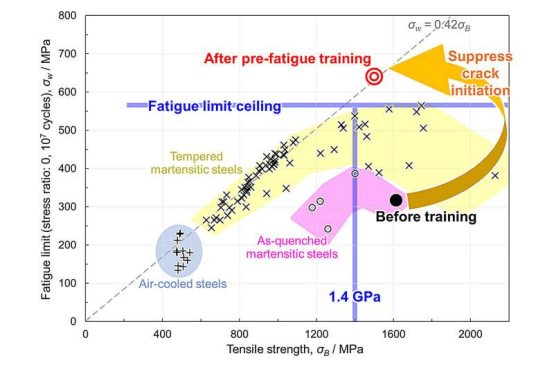
The fatigue limit refers to the stress level at which a material can withstand an infinite number or a sufficiently large number of load cycles without failure when the stress is below this limit. It is proportional to the tensile strength of the steel. However, when the tensile strength exceeds 1.4GPa, further increases in tensile strength do not improve the fatigue limit and may even reduce it — meaning there is an upper limit to the fatigue limit. High-strength steels, represented by martensitic steels, typically exhibit lower fatigue limits but the highest strength in the quenched state. Before practical application, tempering is often performed to improve fatigue performance, but this sacrifices strength. Since the detailed mechanisms behind the upper limit of the fatigue limit remain unclear, there is an urgent need for material design strategies that can overcome this limit.
The research team doubled the fatigue limit of quenched martensitic steel with a tensile strength of 1.6GPa, breaking through the upper limit of the fatigue limit. This was achieved by applying pre-fatigue training under loading conditions that do not cause crack initiation. In-depth analysis revealed that the primary factor in fatigue crack initiation in high-strength steel is the elastic mismatch at grain boundaries — specifically, the elastic strain mismatch in the loading direction. This study is the first in the world to demonstrate that fatigue deformation, traditionally considered harmful, can suppress the above-mentioned crack initiation mechanism. By applying pre-fatigue deformation to quenched martensitic steel, crack initiation is suppressed, significantly improving the fatigue limit.
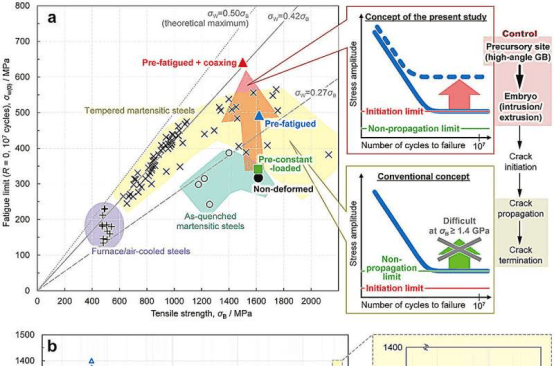
Unlike tempering heat treatment, pre-fatigue training can improve the fatigue limit while minimizing the loss of tensile strength, making it a promising method applicable to general high-strength steels. The study also shows that suppressing crack initiation, rather than traditional crack arrest, is the key to improving the fatigue limit of high-strength steel.
The research team's further goal is to develop "microstructural design strategies for crack-initiation-resistant materials" and apply them to fracture phenomena in various materials, including steel. This will make a significant contribution to making the social application of ultra-high-strength materials more feasible.
This research was conducted by a team from the Steel Research Group at NIMS' Research Center for Structural Materials (RCSM), consisting of Senior Researcher Kazuho Okada, former researcher Kaneaki Tsuzaki, PhD student Eri Nakagawa, and distinguished leader Akinobu Shibata.