
After a decade of exploration, researchers at the Singapore University of Technology and Design (SUTD) have successfully developed a new type of single-rotor aircraft that redefines the efficiency limits of small flying robots. This lightweight drone, inspired by winged seeds (such as maple seeds), weighs only 32 grams yet can hover for 26 minutes under fully autonomous control — far surpassing similar products and marking a major breakthrough in small flying robot technology.
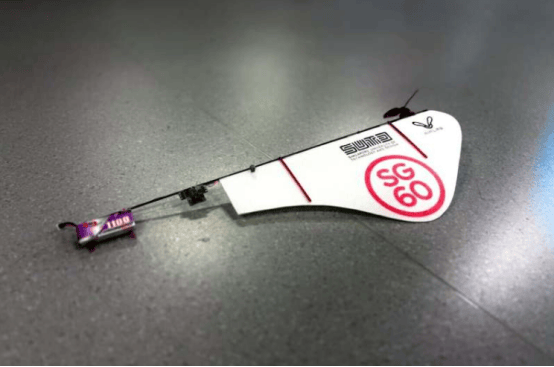
In 2015, to celebrate Singapore's 50th anniversary of independence, Associate Professor Feng Shaohui at SUTD led a team to launch the SG50 multi-rotor drone project, with the goal of designing a drone capable of flying continuously for 50 minutes. Although the project succeeded, the resulting aircraft was bulky and structurally complex. Ten years later, Associate Professor Feng's team shifted focus toward miniaturization, abandoning traditional multi-rotor designs and drawing inspiration from nature to develop this single-rotor aircraft.
In the study published in the IEEE Robotics and Automation Letters, the research team demonstrated this winged-seed-inspired single-rotor aircraft. The autorotating descent pattern of winged seeds provided the perfect combination of passive stability and efficient lift, serving as the source of design inspiration. Through artificial intelligence-optimized wing design, the team efficiently explored a wide range of design possibilities and ultimately achieved a minimalist structure without flapping wings, gearboxes, or mechanical linkages, requiring only one actuator for efficient flight.
The single-rotor aircraft adopts an autorotation and aerodynamic efficiency design. By combining classical aerodynamic theory with actual performance models and fine-tuning wing shape, pitch angle, and mass distribution through data-driven search algorithms, the results show a hovering power loading of 9.1 grams per watt — outperforming other micro-air vehicles of similar size and weight. Researcher Cai Xinyu pointed out that this achievement proves that miniature aerial robots can also achieve endurance comparable to larger systems.
The endurance and simplicity of this single-rotor aircraft provide an ideal solution for low-cost, long-duration flight missions. Currently, the team is exploring its application in lightweight, reusable radiosondes (meteorological sensing and monitoring instruments carried by balloons). The project has already won the 2024 James Dyson Award for Sustainability.
Although the current prototype uses commercially available components, the team plans to develop custom parts to further improve performance. The next goal is to increase payload capacity and flight time while exploring advanced materials and biomimetic wing morphologies. In addition, the team has set a more ambitious target: to build a single-rotor aircraft capable of flying for more than 60 minutes to celebrate Singapore's 60th National Day.
Associate Professor Feng emphasized that the key lies in understanding the underlying physical principles, faithfully modeling them, and using this knowledge to push the limits of small aerial robots. By combining human-centered design with the power of artificial intelligence, the team successfully transformed nature-inspired ideas into a viable technology platform.
As the technology continues to develop, this single-rotor aircraft is expected to play a key role in a variety of mature and emerging applications, demonstrating broad prospects and unlimited potential.