
Researchers have designed a floating amino-grafted (-NH₂) MXene (Ti₃C₂)-based (AMS) sponge. If successfully scaled up, it could provide a sustainable dual solution for the green manufacturing sector — purifying wastewater while supplying farmers with ammonia (NH₃), a plant-essential nitrogen source, at low cost.
More than a century ago, the Haber-Bosch process was invented, converting nitrogen from the air into ammonia fertilizer and saving a world on the brink of famine. The invention also earned two scientists the Nobel Prize. However, the Haber-Bosch process remains one of the most commonly used methods for ammonia synthesis to this day, but it suffers from high energy consumption and high carbon emissions. For every ton of NH₃ recovered, 3.27 tons of CO₂ equivalent are emitted. Recovering ammonia from agricultural and industrial runoff has become a key pathway to reducing emissions and easing the pressure on the chemical industry.
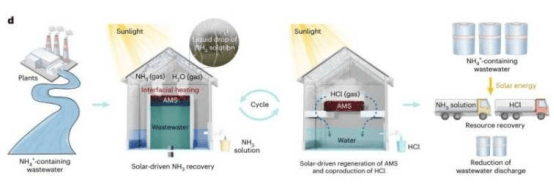
Research results published in the journal Nature Sustainability show that researchers were able to recover ammonia with a purity of 99.8% from ammonium chloride (NH₄Cl) wastewater at a rate of 0.6mol/m²/h under 5 times solar intensity, without adding any chemicals or external energy. The MXene-based sponge fully regenerates under 15 minutes of sunlight exposure and can also produce hydrochloric acid, a valuable by-product with economic value.
Ammonia is a "savior" when in the right place, but when present in runoff and wastewater, it becomes a potent pollutant that harms aquatic life. China alone discharges more than 10 million tons of NH₄⁺-containing wastewater into hydrological systems each year. Recovering NH₃ from NH₄⁺-containing wastewater relies on reversible hydrolysis reactions. Traditional recovery methods require excessive alkaline chemicals and electric heating, whereas interfacial solar heating, as an energy-saving alternative, achieves ammonia recovery through localized photothermal effects.
Taking advantage of this, the researchers proposed a solar-driven ammonia recovery strategy using a floating AMS sponge. Under sunlight, the sponge creates a reversible localized alkaline environment and interfacial heat on the water surface. The grafted -NH₂ groups on the sponge capture H⁺ ions without the need for additional reagents, enabling the hydrolysis of NH₄⁺ into NH₃. The Ti₃C₂ in the float effectively absorbs solar energy and converts it into the heat required for evaporating NH₃, which is then collected through condensation.
Life-cycle and techno-economic analyses show that, compared with traditional methods, this approach has significant environmental and cost advantages. The solar-driven recovery strategy emits only 0.102 tons of CO₂ equivalent, which is 30 times lower than the traditional Haber-Bosch process. However, the researchers also emphasized that further studies are needed to optimize material design for specific wastewater characteristics, seasons, locations, and industry types.