
Although it may look like just an ordinary galaxy among the billions of spiral galaxies in the universe, this image captured by NASA/ESA's Hubble Space Telescope reveals a galaxy with a wealth of research value. The galaxy, named NGC 7456, is located in the constellation Grus and is more than 51 million light-years away from us.
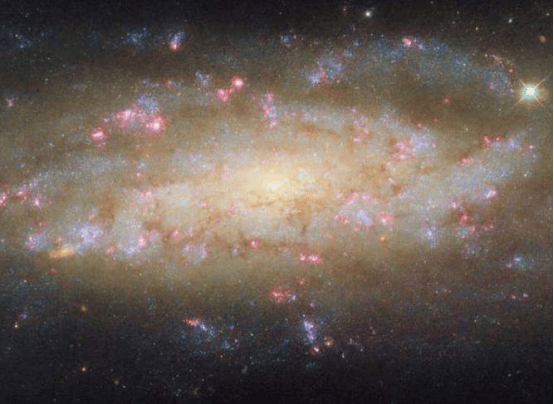
This Hubble image reveals the fine details of the galaxy's mottled spiral arms, behind which lie clumps of faint, obscuring dust. Clusters of bright pink blossoms are rich reservoirs of gas where new stars are forming, illuminating the surrounding clouds and causing the gas to emit this distinctive red glow. The Hubble observations that collected this data focused on the galaxy's stellar activity, tracking new stars, hydrogen clouds, and star clusters to understand how the galaxy evolves over time.
The Hubble Space Telescope is capable of capturing visible light, ultraviolet light, and part of the infrared spectrum, but it is not the only observatory paying attention to NGC 7456. The European Space Agency's XMM-Newton satellite has imaged the galaxy's X-rays multiple times, revealing numerous so-called ultraluminous X-ray sources. These small, compact objects emit extremely powerful X-rays, with intensities far exceeding what researchers would expect based on their size. Astronomers are still working to understand the energy sources of these extreme objects, and NGC 7456 provides more examples.
The region around the galaxy's supermassive black hole is also unusually bright and active, making NGC 7456 an active galaxy. Whether observed at its core or edges, in visible light or X-rays, this galaxy offers astronomers several interesting objects to study.