
A research team from the Department of Chemistry at the University of Copenhagen has developed a new technology that converts PET plastic waste into a carbon dioxide adsorption material. The research results were published in the journal Science Advances, providing a new pathway for the synergistic treatment of plastic pollution and greenhouse gas issues.
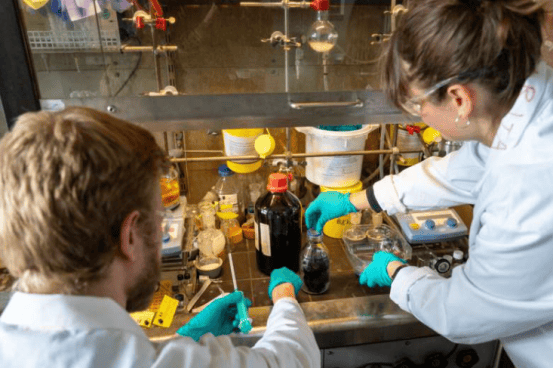
The researchers transformed waste PET plastic into a new adsorption material called BAETA through a chemical modification process. The material has a powdery structure and modified surface properties, enabling it to effectively capture carbon dioxide gas, with performance comparable to existing carbon capture technologies. Experiments show that the BAETA material maintains adsorption activity from room temperature up to 150 degrees Celsius, making it suitable for industrial exhaust gas treatment scenarios.
Project lead Margarita Podreyt said: "The advantage of this technology is that it turns an environmental problem into a climate solution. We use plastic waste that is otherwise difficult to handle to produce functional materials that can reduce greenhouse gases." Co-author Associate Professor Jiwoong Lee added: "The material combines temperature adaptability and long-term stability, making it particularly suitable for high-temperature exhaust gas treatment at the end of industrial chimneys."
Globally, large amounts of PET plastic waste are generated every year. These materials break down into microplastics in the natural environment, causing continuous damage to ecosystems. This technology can convert marine plastic pollution into carbon capture resources, creating dual value in environmental governance and economic incentives. The researchers noted that the synthesis process has mild conditions and possesses industrial-scale-up potential.
The research team is currently advancing tonne-scale production trials and seeking investment to achieve commercial application. This technology demonstrates the possibility of synergistic solutions to cross-domain environmental problems and provides new ideas for the development of a circular economy.