
Researchers from the University of Geneva, in collaboration with the University of Salerno and CNR-SPIN in Italy, have made a new discovery in the field of quantum materials. The team has, for the first time, observed a geometric structure theoretically predicted for many years — "quantum metric" — which can influence the trajectories of electrons moving through materials. The discovery was published in the journal Science and provides a new perspective for the development of quantum electronics.
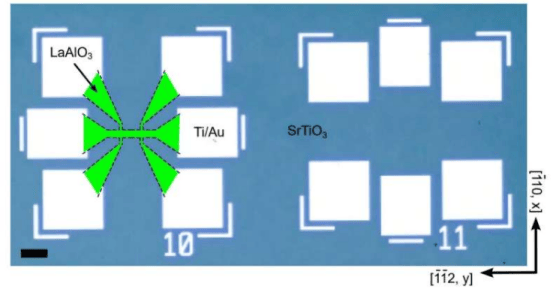
Quantum materials research focuses on developing new forms of matter with superior properties to support technological needs such as high-speed data processing and efficient energy transmission. Quantum metric, as an important component of quantum geometry, reflects the spatial curvature characteristics of electrons moving at the microscopic scale and has a significant impact on the optoelectronic properties and transport behavior of materials. The study successfully captured the presence of quantum metric by analyzing the interface between strontium titanate and lanthanum aluminate oxides.
The research team pointed out that quantum metric can interact with an external magnetic field to alter the paths of electrons moving through solids. Giacomo Sala, researcher in the Department of Quantum Matter Physics at the University of Geneva and first author of the paper, said: "By observing how electron trajectories are distorted under the combined influence of quantum metric and a strong magnetic field acting on the solid, we can reveal its existence." This mechanism provides a new tool for understanding and controlling the electronic behavior of materials.
Quantum metric has long been regarded as a purely theoretical concept and has only gradually entered the experimental research stage in recent years. Andrea Caviglia, Director of the Department of Quantum Matter Physics at the University of Geneva, said: "The concept of quantum metric dates back about 20 years, but for a long time it was viewed as a purely theoretical construct. It is only in recent years that scientists have begun to explore its actual impact on the properties of matter." The study also shows that quantum metric is an intrinsic property of various materials and is not unique to specific systems.
This achievement has a driving effect on the future development of terahertz electronic devices, superconducting technologies, and light-matter interaction research. Caviglia summarized: "These findings open new avenues for exploring and utilizing quantum geometry in various materials, with significant implications for future electronic devices operating at terahertz frequencies, as well as for superconductivity and light-matter interactions."