
According to relevant reports, a team led by Professor Yong-Seok Hwang, in collaboration with the Asia-Pacific Center for Theoretical Physics (APCTP), has experimentally proven for the first time the phenomenon of multi-scale coupling in plasma. The achievement was published in the journal Nature.
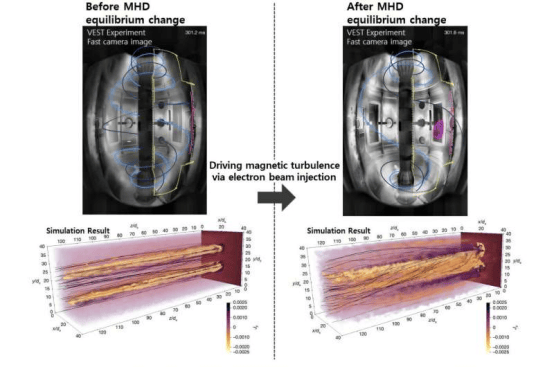
Seoul National University College of Engineering announced that a joint research team led by Professor Yong-Seok Hwang from the Department of Nuclear Engineering, in collaboration with the Asia-Pacific Center for Theoretical Physics (APCTP), has successfully demonstrated the long-standing challenge of multi-scale coupling in plasma by integrating fusion experiments and astrophysical plasma theory. The study was initiated by Professor Hwang and completed independently by three Korean researchers. The team members include Dr. Jong Yoon Park, BK Assistant Professor at Seoul National University and first author of the paper, and Dr. Young Dae Yoon, theoretical physicist at APCTP and corresponding author. This achievement, accomplished entirely by Korean researchers, is regarded as a milestone that significantly elevates Korea's position in global plasma science and technology research.
Plasma is known as the "fourth state of matter," distinct from solids, liquids, and gases. For plasma physicists, explaining how microscopic instabilities drive macroscopic structural changes is a formidable challenge, making multi-scale coupling one of the most fundamental and long-standing problems in the field. Yet plasma is the basic medium for nuclear fusion reactions and the dominant state of matter in the universe. Understanding its multi-scale coupling is crucial for advancing fusion energy technology and uncovering the origins of the cosmos.
Dr. Park and Dr. Yoon's team analyzed experimental data obtained from Seoul National University's fusion device and performed particle simulations using the KAIROS supercomputer at the Korea Institute of Fusion Energy to validate the discovery. The results showed that when microscopic magnetic turbulence is triggered, magnetic reconnection occurs efficiently, subsequently inducing macroscopic structural changes within the plasma. The joint research team proved for the first time that microscopic magnetic turbulence, deliberately induced by a strong electron beam, can increase plasma resistivity, drive magnetic reconnection, and ultimately produce large-scale structural changes. This constitutes the first direct experimental realization and proof of multi-scale plasma dynamics.
This study holds significant interdisciplinary importance as it combines experimental operations from Seoul National University's fusion device with theoretical simulations from APCTP. The achievement also reflects the efforts of Seoul National University and APCTP to provide international development opportunities for young researchers and promote interdisciplinary collaboration. It serves as a typical example of enhancing the global competitiveness of Korean researchers and cultivating future scientific and technological leaders.
Dr. Jong Yoon Park, BK Assistant Professor at Seoul National University, stated that this result is the outcome of countless discussions and debates among experts in nuclear fusion and theoretical physics. Despite their differing interests, they ultimately reached a consensus. In particular, it provides new clues for understanding the onset of magnetic reconnection, which plays a critical role in cosmic phenomena such as solar flares and geomagnetic storms. Dr. Young Dae Yoon from APCTP added that he hopes this research will not only expand the explanatory framework of plasma physics but also lay the foundation for the development of new fusion technologies.