
An international research team led by McGill University has used the James Webb Space Telescope (JWST) to observe the planetary-mass brown dwarf SIMP 0136 and successfully mapped its atmospheric features. The study, published in The Astrophysical Journal, shows that the object's atmosphere exhibits complex and variable weather patterns, providing a new perspective for studying the atmospheric characteristics of exoplanets.
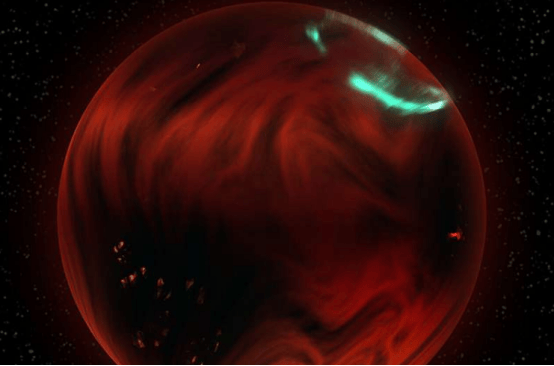
The research team obtained data covering a full rotation period of SIMP 0136 using JWST's Near-Infrared Imager and Slitless Spectrograph (NIRISS). They found that the brightness fluctuations originate from at least three distinct atmospheric layers. Lead author Roman Akhmetshin said: "We are developing new methods to study the meteorological characteristics of similar objects." Observational data revealed cloud structures with varying compositions in the different atmospheric layers, including the detection of materials such as forsterite (magnesium olivine) and iron.
SIMP 0136 is located in the direction of the constellation Pisces, approximately 20 light-years from Earth, and has a mass about 13 times that of Jupiter. As a free-floating planet, its independent motion provides an ideal environment for studying the atmospheres of gas giant planets. Akhmetshin noted: "Although we cannot draw a specific weather map, we found clear north-south asymmetry in certain atmospheric layers." This asymmetric feature indicates that future studies will require two-dimensional models to analyze the atmospheric structure of similar objects.
The study confirms that a single model cannot fully explain the observational data; multiple atmospheric models must be combined to reproduce the spectral features. These findings support the theory that brown dwarfs and giant exoplanets possess active weather systems, with turbulence intensities far exceeding those of Jupiter's atmosphere. As JWST continues its observations, researchers plan to further refine detection methods for exoplanet temperature, cloud layers, and chemical cycles.