
A research team led by Professor Wang Huanqin from the Institute of Intelligent Machines at the Hefei Institutes of Physical Science, Chinese Academy of Sciences, has recently proposed a new semi-supervised method for medical image segmentation. The research results have been published in the academic journal Pattern Recognition. This method aims to address the practical challenges of high cost and low efficiency in pixel-level annotation of 3D medical images.
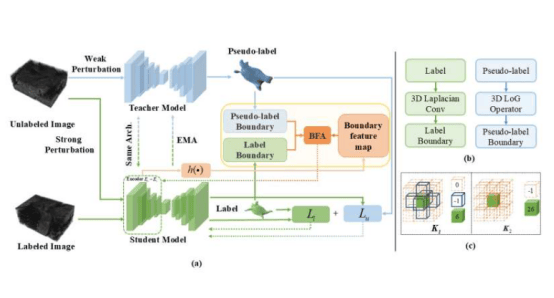
Most current medical image segmentation methods rely on consistency regularization and pseudo-labeling techniques. Their core goal is to enhance generalization performance by improving the model's stability against perturbations. However, such strategies often lead to an imbalance between global features and local boundary details. To tackle this problem, the research team developed a novel boundary feature alignment method that effectively utilizes a small amount of labeled data and a large amount of unlabeled data to achieve a unified boundary feature representation across datasets.
The core component of the method is a high-precision 3D boundary extractor capable of simultaneously capturing information from both real labeled boundaries and pseudo-labeled boundaries. By fusing multi-source boundary features, the model can achieve boundary embedding in the early stages of training, thereby improving the model's generalization ability and alignment consistency under different annotation conditions. The method is built upon the Mean Teacher framework and was systematically validated on three public datasets: LA, Pancreas-CT, and ACDC.
Experimental results show that the method performs well across multiple evaluation metrics. In the ACDC dataset scenario using only 10% labeled data, the method outperforms fully supervised models in metrics such as 95% Hausdorff Distance and Average Surface Distance. This study provides a feasible path to reduce reliance on large-scale labeled data in medical image analysis and has positive significance for advancing related technologies toward clinical application.