
A team of researchers in Australia has successfully developed and tested the world's first roadside technology designed to prevent collisions between animals and vehicles in remote areas — the Large Animal Activated Roadside Monitoring and Alerting (LAARMA) system. The artificial intelligence system's code will be made freely available on GitHub to help researchers and conservationists worldwide develop species-specific models to protect more endangered animals, such as red pandas in Nepal and giant anteaters in Brazil.
The LAARMA project was jointly carried out by the University of Sydney, Queensland University of Technology, and the Queensland Department of Transport and Main Roads, and took 12 months to complete. The system is a low-cost AI roadside device that uses sensors to detect animals near the road and triggers flashing Variable Message Signs (VMS) to warn drivers. In field trials in northern Queensland, LAARMA achieved a 97% accuracy rate in detecting emus and recorded more than 287 sightings, effectively reducing the risk of collisions.
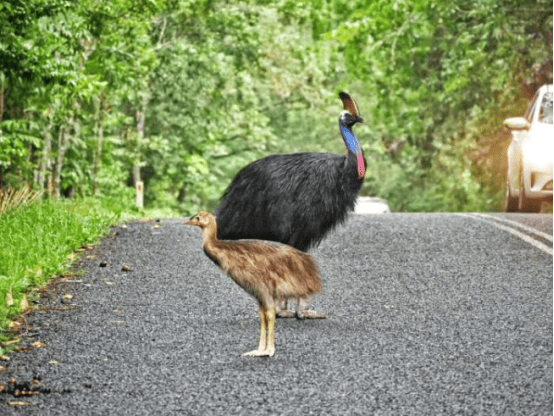
The LAARMA system integrates multiple sensors including RGB cameras, thermal imagers, and LiDAR, and features self-training AI capabilities that allow it to continuously learn and improve without the need for labeled data. At the end of the trial, the system achieved a 78.5% accuracy rate for animal detection within a 100-meter range. In the cassowary hotspot area of Kuranda, LAARMA's recognition rate improved from an initial 4.2% to 78.5%, and drivers' vehicle speeds decreased by up to 6.3km/h. Dr. Li Kunming from the Australian Centre for Robotics at the University of Sydney said: "LAARMA learns by itself and continuously improves — it is a major step toward autonomous wildlife protection."
To complement the animal detection technology, researchers at Queensland University of Technology designed effective roadside warning messages. Through focus group testing, driver surveys, and driving simulator experiments, they ensured the messages effectively prompted drivers to slow down. LAARMA only lights up when animals are detected, making it more effective than permanent yellow signs. Ross Hodgman, TMR North Queensland Regional Director, said the research outcomes are exciting and can significantly improve road safety. iMOVE CRC Managing Director Ian Christensen stated that making the LAARMA system open source will expand its global potential and help governments and environmental organizations around the world address challenges related to wildlife and road safety.