
Researchers at the University of California San Diego have made significant progress in the field of lithium metal battery research. They have developed a simple and effective method to characterize the performance of lithium metal batteries using scanning electron microscopy (SEM). The related research results were published in the Proceedings of the National Academy of Sciences.
Lithium metal batteries have twice the energy storage potential of current lithium-ion batteries. If this potential can be realized, the driving range of electric vehicles will double, and the operating time of laptops and mobile phones will also be extended. However, to achieve this goal, controlling the morphology of lithium deposition on the electrodes during charge and discharge (lithium morphology) is a major challenge. When lithium deposition is uniform, the battery cycle life is longer; otherwise, needle-like dendritic structures form, which can pierce the battery separator, leading to short circuits and failures.
Previously, researchers mainly relied on visual assessment of microscope images to determine the uniformity of lithium deposition. However, this approach led to inconsistencies in analysis between laboratories, making it difficult to compare results across different studies. To solve this problem, the research team (led by Professor Ping Liu from the Department of Chemical and Nano Engineering at the UC San Diego Jacobs School of Engineering, with first author Jenny Nicholas, a PhD student in Materials Science and Engineering) developed a simple algorithm to analyze the uniformity of lithium distribution in SEM images.
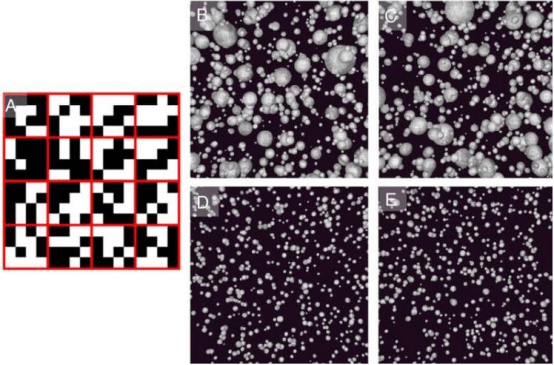
SEM can capture 3D surface features as 2D grayscale images, providing detailed images for battery research. When using the new method, the team first captures SEM images of the battery electrode and converts them into black-and-white pixels, where white pixels represent the topmost lithium deposits in the sample, and black pixels represent the substrate or inactive lithium. After dividing the image into multiple regions, the algorithm calculates the number of white pixels in each region to derive the Dispersion Index (ID). The closer the ID is to zero, the more uniform the lithium ion deposition; the higher the value, the worse the uniformity and the higher the degree of lithium ion aggregation.
The team first validated the method on 2,048 synthetic SEM images with known particle size distributions. The ID measurements were consistent with the actual distributions, confirming its accuracy. It was then applied to real electrode images to analyze how lithium morphology changes over time under different cycling conditions. It was found that as the battery cycles, the ID value increases, indicating more uneven lithium deposition, while the energy required for lithium deposition also increases — a sign of declining battery performance. In addition, before battery failure, local peaks and drops in the inner diameter continue to appear, which can serve as an early warning signal for short circuits.
One of the major advantages of this method is its convenience. Battery researchers already widely use SEM imaging technology and can use this simple algorithm to calculate the ID based on already collected data, elevating the analysis to a new level. This advancement is expected to accelerate the development of safer, longer-lasting, and higher energy-density batteries for electric vehicles and grid-scale energy storage.