
Experts from the Vernadsky Institute of Geochemistry and Analytical Chemistry of the Russian Academy of Sciences (GEOKHI RAS), in collaboration with their Russian and Chinese counterparts, have proposed an innovative method for processing coal-fired power plant ash and extracting valuable aluminum metal. The technology combines pressurized acid leaching with ion exchange solution purification, bringing new possibilities for a resource-saving economy. The research results have been published in the authoritative journal Separation and Purification Technology.
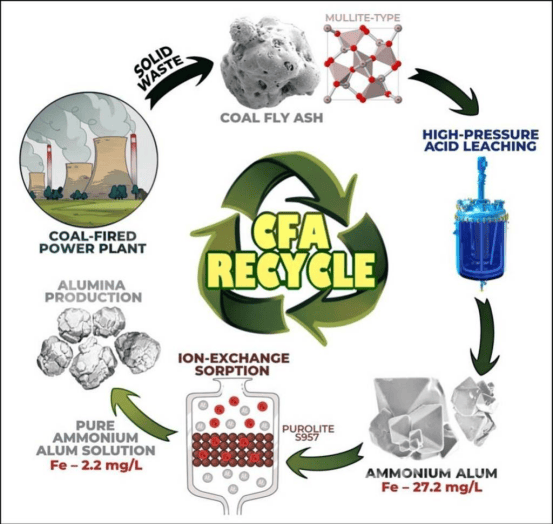
Globally, coal-fired power plants produce approximately 1 billion tons of ash each year, most of which is arbitrarily stockpiled, occupying land and polluting the environment. However, the aluminum oxide content in the ash can reach up to 40%, making it a key raw material for producing metallic aluminum. As the world's largest aluminum producers, Russia and China suffer from shortages of bauxite and must import raw materials from equatorial countries such as Guinea and Ghana. The development of this technology makes it possible to use coal fly ash as an alternative source of aluminum, reducing import dependence and solving the problem of energy waste disposal.
The new method developed by GEOKHI RAS consists of three key stages. The initial magnetic separation stage can remove up to 34% of the magnetic iron fraction, leaving a non-magnetic fraction with a higher aluminum content (26.76% Al₂O₃). Next, leaching is carried out with a mixture of ammonium bisulfate (NH₄HSO₄) and sulfuric acid (H₂SO₄) at 160–200°C, extracting up to 78% of the aluminum within 90 minutes, while silicon dioxide remains in the solid residue. Finally, the solution is purified using ion exchange resin. The S957 resin can reduce the iron concentration by 12 times (from 27.2mg/L to 2.2mg/L) while retaining the possibility of regenerating the resin with sulfuric acid.
The lead author of the paper, Dmitry Valeev, conducted the pilot test at a chemical plant in Zaozhuang City, Shandong Province, China. Dmitry Valeev, Chief Researcher of the Laboratory of Adsorption Methods at the Vernadsky Institute of Geochemistry and Analytical Chemistry of the Russian Academy of Sciences and Doctor of Sciences, explained: "This technology has great economic potential, generating a profit of 11,500 rubles per ton of ash processed. The process can produce three valuable products: metallurgical alumina, iron-containing magnetic fraction, and silica residue suitable for building materials or silicon carbide-based ceramics. From an environmental perspective, the method can significantly reduce ash stockpiling and minimize environmental impact."
At present, the technology has successfully passed laboratory testing and is ready to enter the pilot stage to test parameters at industrial scale. Its versatility not only opens prospects for ash processing but also provides possibilities for processing other aluminum-containing raw materials (such as red mud, recycled aluminum slag, high-silicon bauxite, or kaolin), greatly expanding the potential range of applications.