
For researchers at the Grainger College of Engineering at the University of Illinois Urbana-Champaign, a new path to reducing carbon emissions may be hidden in salad dressing condiments.
In 2020, the U.S. federal government committed to achieving net-zero carbon emissions by 2050, and the adoption of sustainable aviation fuel (SAF) is an important step toward carbon neutrality. SAF is a renewable raw material-based alternative to conventional aviation fuel. As part of this initiative, engineers at Grainger have been working on developing key nanocatalysts to convert bio-crude oil from food waste such as salad dressing into SAF.
Professor Hong Yang of Chemical and Biomolecular Engineering and Professor Yuanhui Zhang of Agricultural and Biological Engineering joined forces to tackle the challenge. Their research results, published in Science Advances, propose a low-cost, scalable, and reusable catalyst — the first use of non-precious metal carbide catalysts to produce SAF from bio-crude oil derived from kitchen waste.
Professor Zhang noted that North America has actively begun producing SAF, but much of it competes with food supplies such as soybean oil. The United States currently consumes about 40 million tons of aviation fuel annually, with SAF accounting for only about 1%. Using only bio-waste could increase this proportion to 10–20%.
Unlike traditional aviation fuel derived from fossil crude oil, SAF is made from renewable resources such as biomass, energy crops, kitchen waste, sewage sludge, and algal blooms. For nearly thirty years, Professor Zhang's laboratory has been using hydrothermal liquefaction (HTL) technology to liquefy organic waste into bio-crude oil. This technology mimics the natural formation process of fossil crude oil, shortening the conversion time from millions of years to just half an hour.
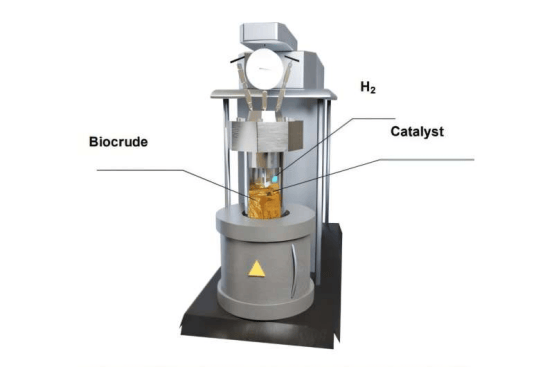
Yang and Zhang believe that addressing carbon emissions and food waste can be achieved simultaneously. The researchers collected food waste from the Kraft Heinz plant in Champaign, Illinois, converted it into bio-crude oil using HTL, and then upgraded it with a non-precious metal carbide catalyst developed in Yang's laboratory. Yang explained that the outer electrons of molybdenum carbide can interact with bio-crude oil molecules to remove oxygen.
The team chose salad dressing as a specific food waste because it is pre-processed, homogeneous, and energy-dense. Through catalytic conversion, excess oxygen in the bio-crude oil can be removed and converted into hydrocarbon fuel. Yu Siying, a graduate student in Chemical and Biomolecular Engineering and first author of the paper, stated that the catalyst still needs fine-tuning, such as adding iron atoms, to produce fuel molecules with molecular weights similar to those of fuel components.
Looking ahead, Professors Zhang and Yang will continue to collaborate to improve catalyst design, enabling better conversion of bio-crude oil made from other biological wastes to meet SAF standards, such as those applicable to biological feedstocks like algae and sewage. The metal carbide nanocatalysts they developed can also be used to study SAF production from fermentation products of oleochemicals and crop feedstocks.
Professor Yang noted that long-haul air transportation lacks good alternatives to conventional aviation fuel, making SAF research essential. Students are passionate about this research topic and eager to engage in studies that can change the world.
Other co-authors of this study include Haozhen He, Runnan Gao, and Anran Song from the Department of Chemical and Biomolecular Engineering; Sabrina Summers and Sibuchun Si from the Department of Agricultural and Biological Engineering; and Zhibin Yang and Joshua Heyne from Washington State University. Zhibin Yang is affiliated with the Department of Chemistry, Materials Research Laboratory, Prairie Research Institute, and the Center for Advanced Bioenergy and Bioproducts Innovation at Washington State University.