
An international research team has made significant progress in fungicide research by developing a mathematical model that can calculate the economic costs and hidden costs of fungicide resistance. This provides a new approach for the rational use of fungicides in agriculture. The research was conducted with the participation of Professor Chaitanya Gokhale of Theoretical Evolutionary Biology at the University of Würzburg (JMU) and others, and was published in the journal PLOS Sustainability and Transformation.
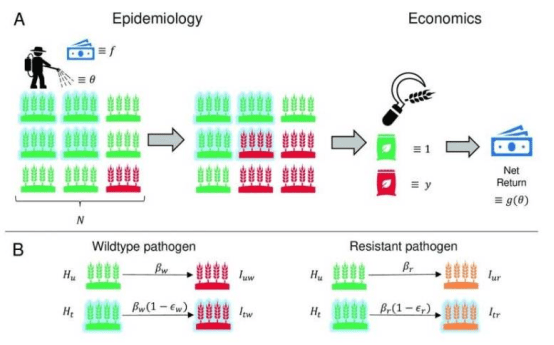
Fungicides, as plant protection products used to control fungal diseases and ensure crop yields, are widely applied in agriculture. However, excessive use of fungicides brings many drawbacks, such as the emergence of resistant pathogens and even the infection of neighboring fields.
In this study, the researchers constructed a new mathematical framework by combining a model capable of computing the spread of fungal diseases across multiple fields with economic analysis methods. Professor Chaitanya Gokhale of JMU pointed out that the economic cost of fungicide resistance is difficult to determine, as yields can increase or decrease depending on specific conditions, with the highest resistance costs arising from moderately aggressive pathogens. The study also found that although intuitively the total economic cost would rise with increasing resistance and yield loss, in reality, when fungicide prices increase, the total economic cost actually decreases. In addition, biological factors such as the level of resistance in the pathogen population, the basic reproduction number, and field yield losses caused by fungal infections all influence the costs.
Professor Chaitanya Gokhale stated that this study provides a mathematical framework for policymakers and stakeholders in the agricultural sector, upon which effective measures for the sustainable use of fungicides can be designed. This will not only help safeguard crop yields and reduce unnecessary chemical use, but also ensure long-term food security.
Since the current results are only a theoretical model, the researchers believe that further data collection and empirical studies are needed in the future to test its practical application effects in agriculture.