
When Larissa Novelino began her engineering career, she never imagined she would develop such a deep connection with origami. "I'm not someone who is into crafts or art. My mom still can't believe that I fold origami," Novelino said.
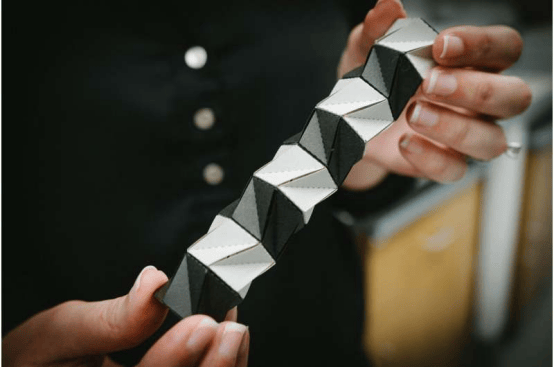
Now an Assistant Professor of Civil and Environmental Engineering at Rice University, her research is based on the centuries-old Japanese art of origami. However, in her laboratory, origami means far more than creating shapes like cranes and swans — it is about changing the way buildings, materials, and machines are designed.
Origami engineering applies the geometric principles behind folding to real-world challenges, creating structures that are compact when stored and can unfold into strong and practical shapes. Novelino uses these principles to design a wide range of products, from portable emergency shelters to lightweight materials with unique mechanical properties. She says the possibilities are endless: "With geometry, we can design how materials behave — their stiffness, weight, and even their response in different directions. We can make an object deployable in one direction while remaining rigid and load-bearing in another."
One of Novelino's greatest aspirations is to use origami principles to make construction safer and more efficient. "Construction sites are extremely dangerous. If we can design structures that fold flat for easy transport and deploy with minimal human risk, we can make job sites much safer. This is not innovation for novelty's sake — it's innovation for saving lives," she said.
Novelino's designs are not limited to the field of architecture. She has also researched origami-inspired electromagnetic filters that can change their operating frequency by altering shape, as well as soft robots that fold into new positions to perform different tasks. "Origami allows us to visualize these concepts and test them. We can make prototypes out of paper, explore ideas with our hands, and then scale them up using advanced materials," Novelino said.
At Rice University, Novelino's students quickly discover that in her classes, they not only solve equations — they also "fold" them. "They are always surprised that folding a piece of paper can teach so much about geometry, mechanics, and design. It's an intuitive and practical way to understand abstract concepts that appear on a computer screen," Novelino noted.
Novelino grew up in Belém, Brazil, where she excelled in mathematics, but she entered the field of origami engineering almost by chance. While pursuing her master's degree in structural engineering, she met an American professor whose research had shifted from traditional computational mechanics to origami-inspired structures. "It felt great to step away from the computer for a while and work with a laser cutter and 3D printer. I'm not very strong visually, so folding structures with my own hands and seeing how they work is crucial to my work. For me, it's the perfect combination — it's still mathematics and mechanics, but with a completely new way of understanding," Novelino said.