
An international team of scientists has drawn inspiration from how animals such as bats, whales, and insects use acoustic signals for communication and navigation, successfully simulating swarms of micro-robots. These robots coordinate their actions through sound waves to form large groups exhibiting collective intelligence similar to living organisms. The research results were published in the journal Physical Review X.
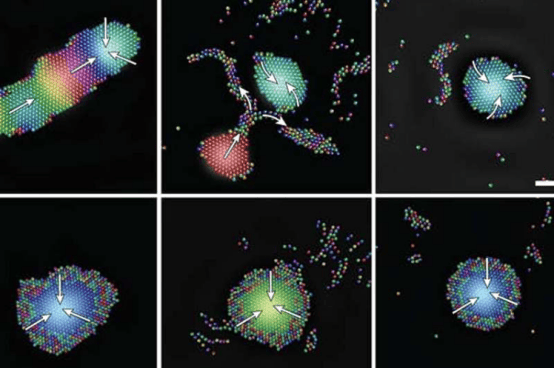
The team leader, Igor Aronson, Huck Chair Professor at Pennsylvania State University, stated that these robotic swarms hold promise for performing complex tasks in the future, such as exploring disaster zones, cleaning up pollution, or even carrying out medical procedures inside the human body. Using swarms of bees or midges as examples, he explained that these robotic groups can maintain cohesion through sound, functioning as a single unified entity.
These micro-robotic swarms offer unique advantages. Because they can self-organize and emit sound, they can navigate in confined spaces and spontaneously reassemble after changing shape. Their collective intelligence may be used in the future to clean up pollutants in contaminated environments. Inside the human body, they could deliver drugs precisely to targeted areas, with their collective sensing capabilities detecting environmental changes and "self-healing" abilities allowing them to continue operating as a whole even after partial disintegration — offering great potential for threat detection and sensor applications.
Aronson noted that this research represents an important step toward creating smarter, more resilient, more practical, and less complex micro-robots. The insights are crucial for designing the next generation of micro-robots capable of performing complex tasks in challenging environments and responding to external cues.
To conduct the study, the team developed computer models to track the motion of micro-robots, with each robot equipped with acoustic emitters and detectors. The research found that acoustic communication enables the robots to collaborate seamlessly and adjust their shape and behavior according to the environment, much like schools of fish or flocks of birds.
Aronson explained that the robots in the paper are computational agents in a theoretical model, but the collective intelligence observed in the simulations is likely to appear in experimental studies using the same design. Surprisingly, these simple electronic circuit robots — equipped only with motors, miniature microphones, speakers, and oscillators — demonstrated collective intelligence. They were able to synchronize their own oscillators with the frequency of the group's acoustic field and migrate toward the direction of the strongest signal.
This discovery marks a new milestone in the emerging field of "active matter," which studies the collective behavior of self-propelled microscopic biological and synthetic agents. For the first time, the study demonstrates that acoustic waves can serve as a means of controlling micro-robots. Previously, active matter particles were mainly controlled through chemical signals, whereas acoustic waves are more effective for communication — propagating faster, over longer distances, with less energy loss, and with simpler design. This allows robots to effectively "hear" and "find" each other, achieving collective self-organization.
Other authors of the paper include Alexander Ziepke, Ivan Maryshev, and Erwin Frey from Ludwig Maximilian University of Munich.