
A research team from Sungkyunkwan University in South Korea has developed a handheld in-situ 3D printing device capable of directly printing customized bone graft scaffolds at fracture sites during surgery. The research results were published in the journal Device, providing a new technical solution for bone defect repair.
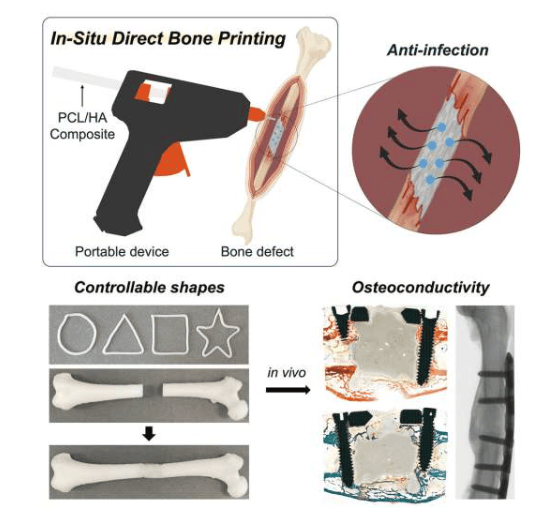
The device is based on a modified glue gun structure and uses composite filaments made of hydroxyapatite (HA) and polycaprolactone (PCL) as printing materials. The biocompatible thermoplastic PCL liquefies at a low temperature of 60°C, allowing it to adapt to irregular bone defect shapes while avoiding thermal damage to surrounding tissues. By adjusting the ratio of HA to PCL, the research team can achieve personalized customization of the hardness and strength of the graft material.
Project leader Associate Professor Jung Seung Lee stated: "This technology eliminates the need for preoperative imaging and prefabrication processes, enabling precise anatomical matching even for complex bone defects." Experiments showed that the device can complete the on-site fabrication of the graft scaffold within minutes, significantly shortening surgery time. The researchers also incorporated antibacterial compounds such as vancomycin and gentamicin into the filaments, enabling the scaffold to provide sustained local drug release for several weeks.
In a rabbit femoral fracture model, the transplanted scaffolds demonstrated good biocompatibility, with no signs of infection or necrosis observed 12 weeks after surgery. Compared with traditional bone cement grafts, the 3D-printed group showed superior bone regeneration effects in key parameters such as bone surface area and cortical thickness. Lee added: "The scaffold design supports biological integration and gradual degradation, ultimately being replaced by new bone tissue."
The team's next steps will focus on optimizing antibacterial performance and advancing to large animal experiments in preparation for clinical application. This in-situ printing technology provides a new approach for real-time and precise repair in orthopedic surgery and is expected to become a practical solution for immediate bone repair in operating rooms.