
To more realistically simulate fluid motion, especially the interaction between water flow and air, researchers at the Munich University of Technology (TUM) have developed a new method. This method breaks through the limitations of traditional computer graphics simulations by using a "two-phase simulation" process that simultaneously considers both water and air states, significantly improving the realism and accuracy of the simulation.
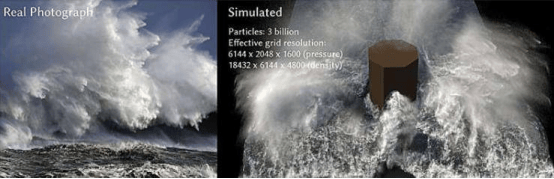
In natural phenomena, the splashes caused by waves hitting the coast and the vortices in the surrounding air have always been difficult points in digital simulation. Traditional methods mostly focus on simulating the water surface while ignoring the interaction with air, resulting in obvious differences between the simulation effect and reality. TUM Professor of Physics Simulation Nils Thuerey stated: "The new method can more realistically present details such as aerosols and air vortices, bringing a qualitative leap to fluid simulation."
The new method adopts a hybrid simulation strategy that combines the advantages of grid and particle simulation. Grid simulation is responsible for calculating physical properties such as velocity and pressure, while particle simulation captures fluid motion and distribution. This dynamic adaptation to the complexity of wave motion allows the simulation to self-optimize in the most active motion areas while saving resources in less active areas. First author of the study and PhD student Bernhard Braun said: "The new method saves a lot of computing power and can efficiently calculate highly complex fluctuations on standard systems, while simplifying the calculation of pressure differences between air and water — a major breakthrough in two-phase simulation."
Fluid simulation technology not only plays a key role in big-budget movie special effects but also shows great potential in fields such as oceanography. By simulating extreme situations such as huge waves and even dam breaches, this technology helps better protect coastal areas from floods and other extreme weather events, providing scientific basis for coastal protection.