
At 9:50 on April 15, the HH-200 commercial unmanned air transport system, independently developed by the Aviation Industry Corporation of China, smoothly landed at the Weinan Operation Base of the AVIC Civil Aircraft Flight Test Center, successfully completing its maiden flight. All systems of the aircraft operated normally, the flight attitude was stable, the overall condition was good, and the scheduled flight subjects were accomplished as planned, marking new progress for China in the field of large commercial unmanned transport equipment.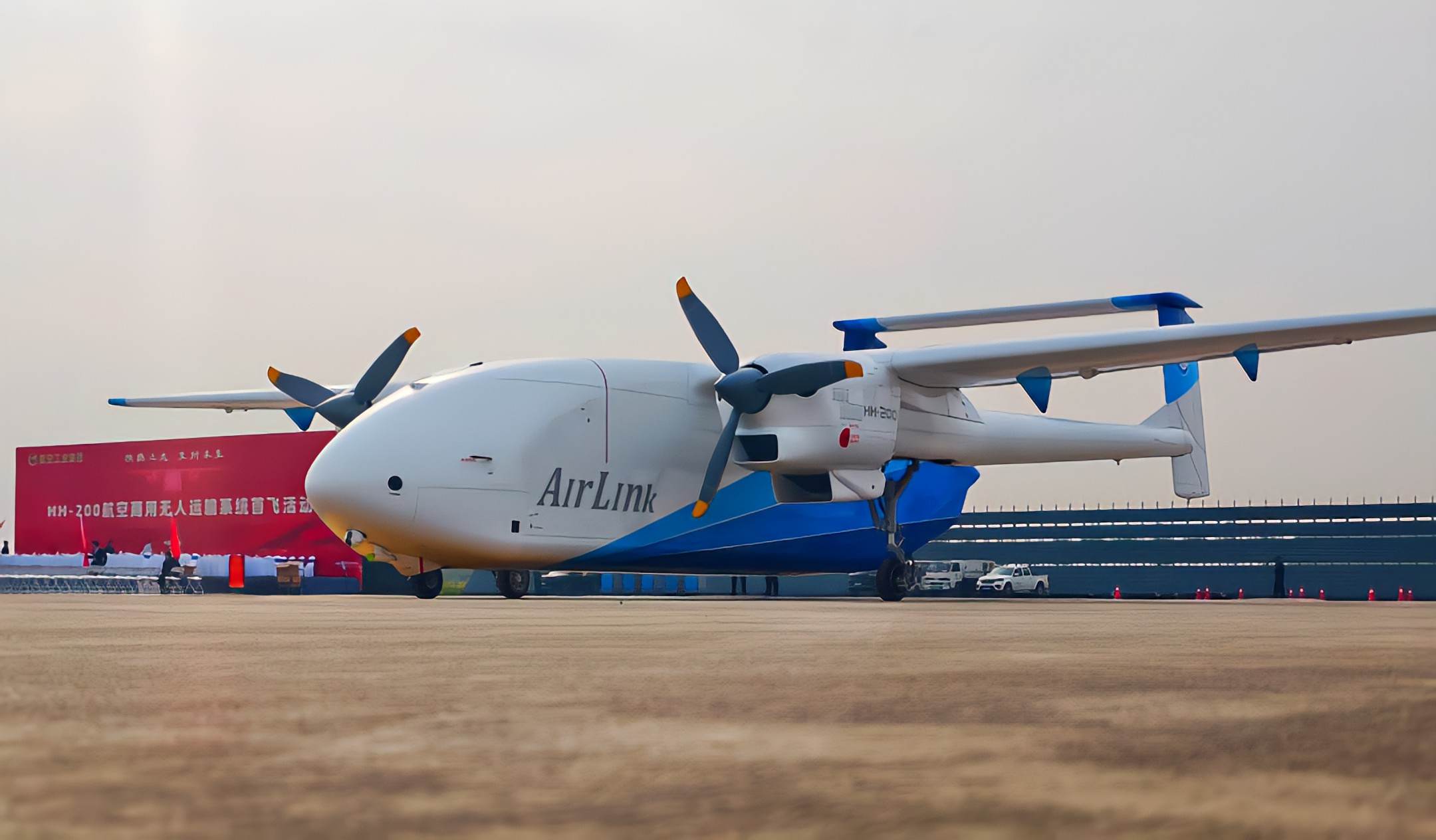
"The aircraft's flight status in the air was stable, it responded to ground commands accurately and quickly, and the coordination between air and ground throughout the flight was very smooth," said Liu Xinchang, the pilot of the HH-200. The HH-200 features a square straight-through fuselage, twin-engine high-wing, and twin-boom layout. It has a length of 12.2 meters, a wingspan of 16.8 meters, a height of 3.7 meters, a standard cargo hold volume of 12 cubic meters (expandable to 18 cubic meters), a maximum payload of 1.5 tons, a maximum cruising speed of 310 km/h, and a maximum range of 2,360 kilometers.
"One of the greatest challenges during the development process was balancing performance, safety, and cost. We adopted innovative structural design and manufacturing technologies, extensively using composite material structures to achieve a 20% weight reduction while effectively lowering costs," explained Meng Fantao, the technical leader of the "Xinzhou Honghu" HH series commercial unmanned air transport system. Designed according to civil aviation standards, the HH-200 operates with full intelligent autonomous flight and AI intelligent obstacle avoidance. It has a service life of 50,000 flight hours and 15,000 flight cycles, with a lifecycle operating cost of 4.7 yuan per ton-kilometer, which is only one-third of that of manned aircraft of the same class. Additionally, the HH-200 features a straight-through low cargo hold, a morphable tail, and a Π-shaped empennage. The loading and unloading area is spacious and open, compatible with unit load devices and standard pallets, and can seamlessly interface with ordinary forklifts and other loading equipment, enabling two operators to complete cargo loading or unloading within five minutes.
In practical applications, the HH-200 demonstrates outstanding environmental adaptability. It can take off and land on runways as short as 500 meters and at high-altitude airports above 4,200 meters, adapting to extreme temperatures ranging from -40°C to 50°C and complex weather conditions. This capability effectively bridges transportation gaps in mountainous areas, islands, snowy regions, plateaus, and other regions, establishing efficient low-altitude logistics channels. Currently, the HH-200 primarily serves China's border, coastal, and cross-border regional cargo routes, inland point-to-point small cargo logistics, inter-island cargo transport in Southeast Asia, and the air cargo network of countries along the Belt and Road Initiative. In the future, this model can be quickly adapted into multi-mission configurations such as emergency rescue, forest firefighting, weather modification, aerial remote sensing, and agricultural and forestry plant protection.
Previously, the HH-200 has already secured a total of 20 intended orders. It will engage in in-depth cooperation with companies such as JD.com Tiantong Technology and YTO Express to jointly promote the commercial application of the "Xinzhou Honghu" HH series commercial unmanned air transport system, accelerating the deployment of unmanned aerial cargo transportation scenarios.