
The Bioelectronics & Microsystems Laboratory at Binghamton University, led by Professor Seokheun "Sean" Choi, has developed a new manufacturing technology that uses a standard carbon dioxide laser to directly write electronic circuits on commercial baking paper. The related results have been accepted for publication in the journal ACS Applied Materials & Interfaces.
Baking paper has a thin silicone coating on its surface, making it waterproof. The team used laser precise positioning to remove the coating in specific patterns, exposing the underlying absorbent cellulose fibers. These channels guide water-based conductive ink to form electronic components such as resistors and capacitors, all integrated on a single sheet of paper. Professor Choi said: "The laser is essentially writing wettability on a non-wettable surface. Where the laser touches, the paper reacts to the functional ink."
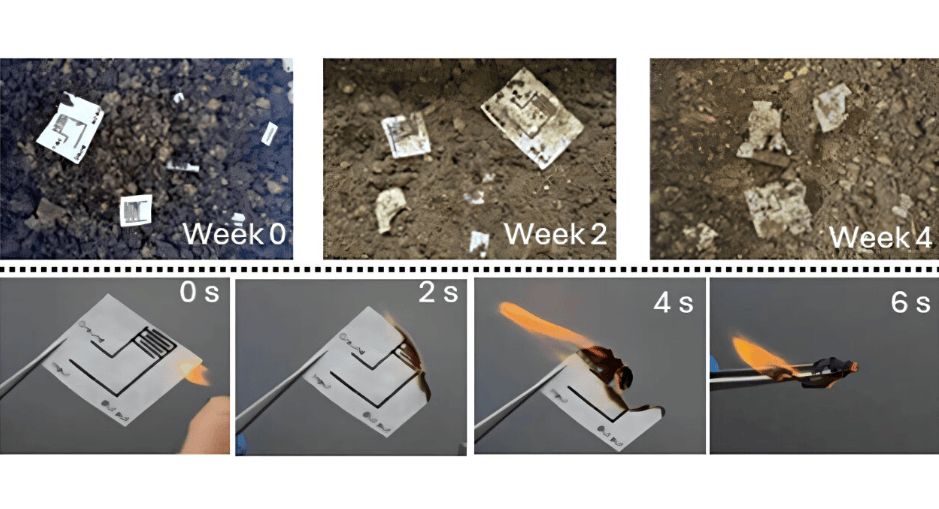
This achievement is the culmination of more than ten years of "paper electronics" research in Professor Choi's laboratory. Previously, the team had made a series of innovations in bio-batteries and paper-based biosensors, but circuit manufacturing had limitations. The first fully integrated paper circuit board demonstrated in 2024 had minimum achievable features of only about one millimeter due to the wax barrier blurring and diffusing when heated. The large circuit volume hindered practical applications.
The new laser technology breaks this barrier. Starting with hydrophobic baking paper, the laser generates hydrophilic channels, with circuit widths as small as 250 micrometers and spacing of 300 micrometers — an improvement of two to three times — allowing a complete filter circuit to fit into a millimeter-scale footprint. The electronic components manufactured by the team perform well, and the functional inks are all water-based. The circuits are biodegradable and can have their service life extended through a thin silicone encapsulation layer.
Professor Choi published a forward-looking article in the journal Device, outlining a path to integrate paper electronics and paper fluidics into intelligent paper-based systems. He believes that the fusion of the two can unlock new self-powered, self-sensing disposable devices for applications in medical and other fields. The research was led by Dr. Zahra Rafiee and Ruohan Zhang. Professor Choi said: "Imagine a bandage that can monitor wound infection and wirelessly alert your phone — when you're done with it, you throw it into the compost bin."