
Millions of tons of chromite beneficiation tailings are generated globally each year, with long-term stockpiling not only occupying land but also causing significant waste of rare metal resources. A joint team from Satbayev University in Kazakhstan and the CSIR National Metallurgical Laboratory in India has developed a sequential thermochemical-hydrometallurgical processing route, achieving a 98-99% chromium extraction rate from the tailings and remarkable enrichment of platinum group metals (PGMs) in the residual phase—with local platinum content reaching as high as 3.8 wt.%. This breakthrough was published as the cover paper in Volume 16, Issue 4 of MDPI's flagship journal, Minerals, in 2026.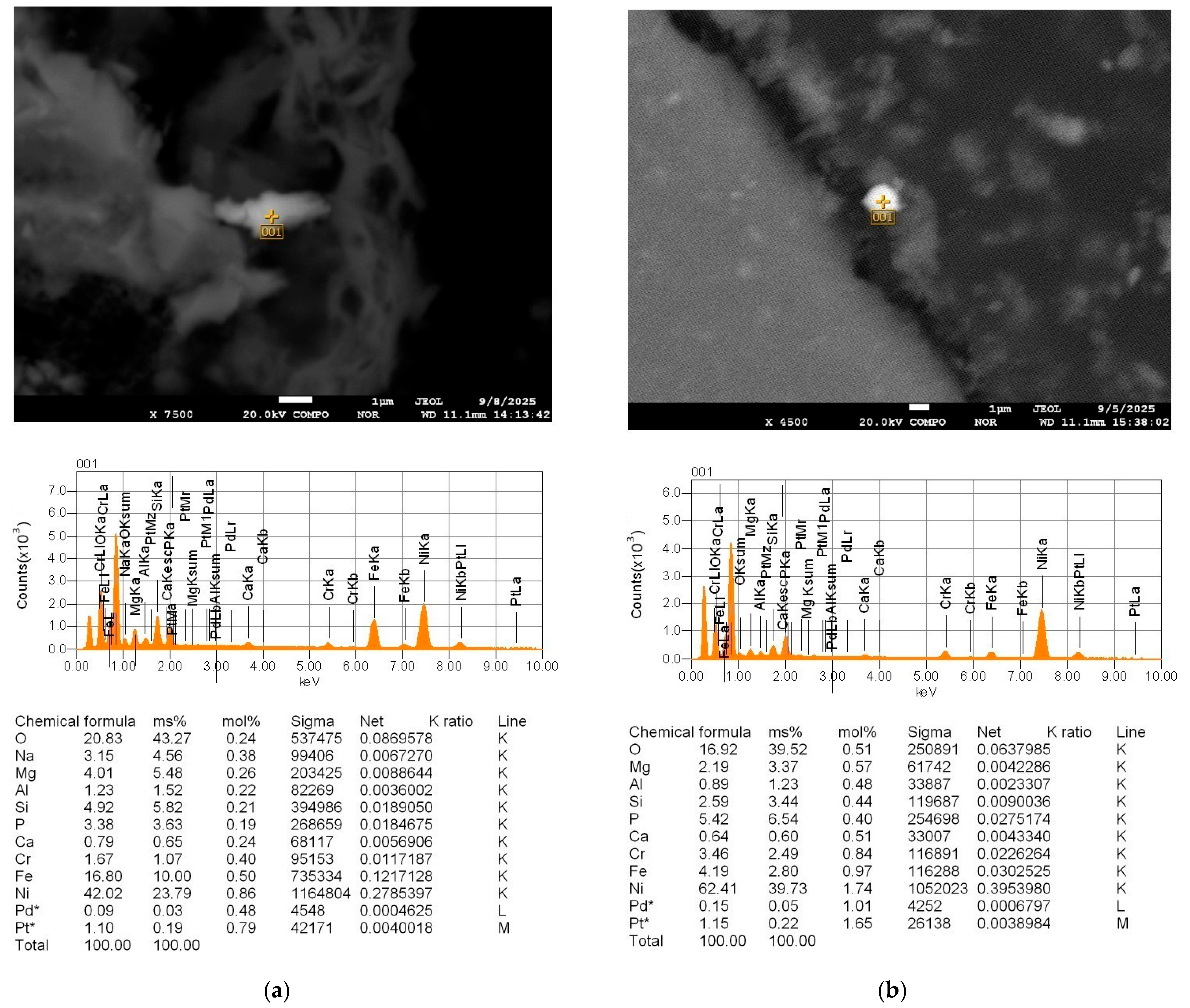
Chromite beneficiation tailings (CBTs) represent both a significant environmental challenge and a vast reservoir of unrecovered valuable metals. Approximately 84% of the world's chromite reserves are concentrated in South Africa, Kazakhstan, and Zimbabwe, with large-scale beneficiation inevitably producing massive amounts of tailings.
Process Route: Three Steps with Distinct Focuses
The research team developed a sequential thermochemical-hydrometallurgical processing route for CBTs sourced from the Donskoy Mining and Processing Plant in Kazakhstan:
Sodium Carbonate Alkaline Sintering-Water Leaching: After co-sintering with Na₂CO₃ at 1000°C followed by water leaching, 98-99% of the chromium enters the solution, while the residual phase enriches non-ferrous metals, rare earth elements, and platinum group metals (PGMs);
Sulfation Roasting-Water Leaching: Promotes the dissolution of magnesium, nickel, and rare earth elements;
PGM Residual Enrichment: Due to the low solubility of platinum and palladium under the applied conditions, they are primarily retained in the solid phase.
Microscopic Mechanism: Localized PGM Enrichment up to 3.8 wt.%
Scanning Electron Microscopy-Electron Probe Microanalysis revealed a key finding: platinum group metals are selectively enriched in nickel-containing microscopic inclusions, with local platinum content reaching as high as 3.8 wt.% in nickel-rich areas.
From "Environmental Liability" to "Strategic Metal Resource"
This sequential processing strategy achieves both the efficient recovery of chromium and significant enrichment of PGMs in the residual phase, demonstrating the enormous potential of CBTs as a secondary resource for integrated multi-metal recovery. This research provides a replicable technological paradigm for the resource utilization of similar beneficiation tailings worldwide and holds significant importance for securing the supply chain of critical metals.