
A research team from the Institute of Modern Physics (IMP) of the Chinese Academy of Sciences, in collaboration with the University of Science and Technology of China (USTC), has successfully achieved the direct detection of the extremely rare radioactive isotope argon-42 in the atmosphere. The isotopic abundance of argon-42 in the atmosphere is on the order of 10⁻²¹. This achievement improves detection sensitivity by 4–5 orders of magnitude and provides a new method for measuring ultra-low abundance isotopes. The relevant research was published in the journal *Nature Physics* on April 14.
Argon-42 is produced by the interaction of cosmic rays with the atmosphere and has a half-life of 33 years. Its decay products may affect the detection accuracy of dark matter and double beta decay experiments. Traditional measurement methods, such as decay counting in liquid argon detectors and accelerator mass spectrometry, have limitations and cannot directly measure the extremely low abundance of argon-42 in the atmosphere.
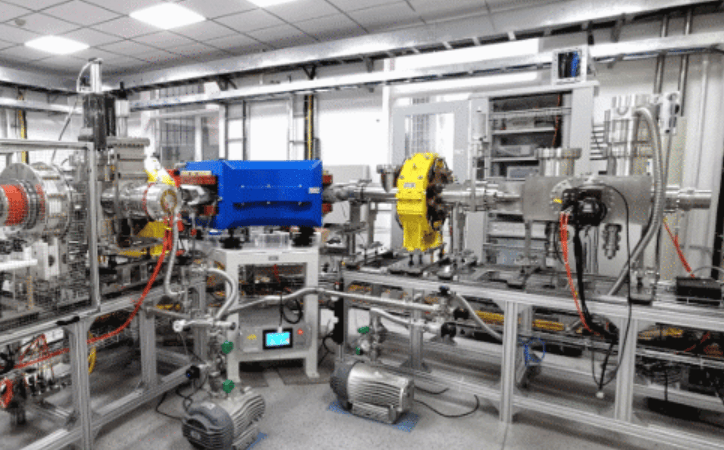
The USTC team employed the atom trap trace analysis (ATTA) technique to achieve single-atom detection of argon-42. This technique uses resonant laser cooling and trapping to capture target atoms, followed by fluorescence imaging for counting, offering high selectivity and sensitivity. The high-current electromagnetic mass spectrometer developed by IMP pre-enriched argon-42, increasing its abundance by more than 700 times and improving detection efficiency. Over 43 days, the team observed 204 argon-42 atoms and measured the isotopic abundance of atmospheric argon-42 to be (6.1 ± 0.5) × 10⁻²¹.
The ATTA technique has been applied in fields such as glacier dating and groundwater age tracing. The high-precision electromagnetic separation technology from IMP shows application potential in stable isotope studies. This collaboration has expanded the detection range of this technique, and in the future, it can be used to measure more extremely rare isotopes, supporting fundamental physics and environmental science research.
The co-first authors of the paper are Dr. Wan Zhaofeng and Liang Jiawei from USTC, with Engineer Jia Zehua from IMP as the third author. The research was supported by the National Major Science and Technology Projects and the National Natural Science Foundation of China, among other institutions.