
Professor Sun Xiaohui's team from Shenzhen University in China, in collaboration with Professor H.J.H. Brouwers' team from Eindhoven University of Technology in the Netherlands, published a study in the journal Cement and Concrete Composites, innovatively proposing carbonation coating (CC) technology. For the first time, they designed a CaCO₃@IBA core-shell structured aggregate, simultaneously producing high-value-added precipitated calcium carbonate (PCC) as a byproduct.
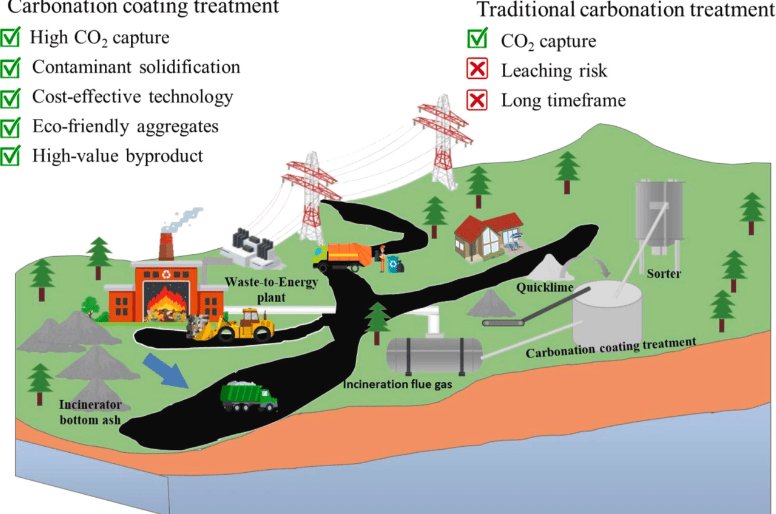
The global annual production of municipal solid waste has reached 2.01 billion tons and is projected to rise to 3.4 billion tons by 2050. Incineration bottom ash (IBA) constitutes 80% of the total weight of incineration residues, with annual production in Europe alone reaching 20 million tons. Traditional landfill disposal not only wastes land resources but also misses the opportunity for solid waste valorization. Meanwhile, directly substituting natural aggregates with IBA in building materials poses risks of pollutant leaching, including heavy metals, chlorides, and sulfates. Existing carbonation technologies generally suffer from low carbon capture efficiency, incomplete pollutant immobilization, and difficulty in controlling soluble salts.
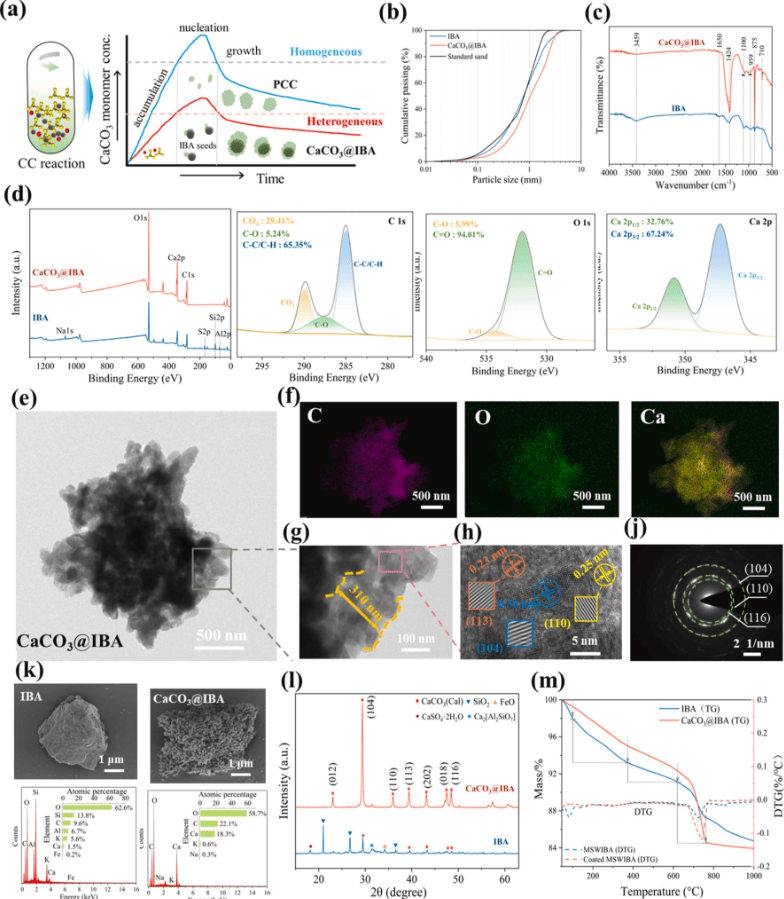
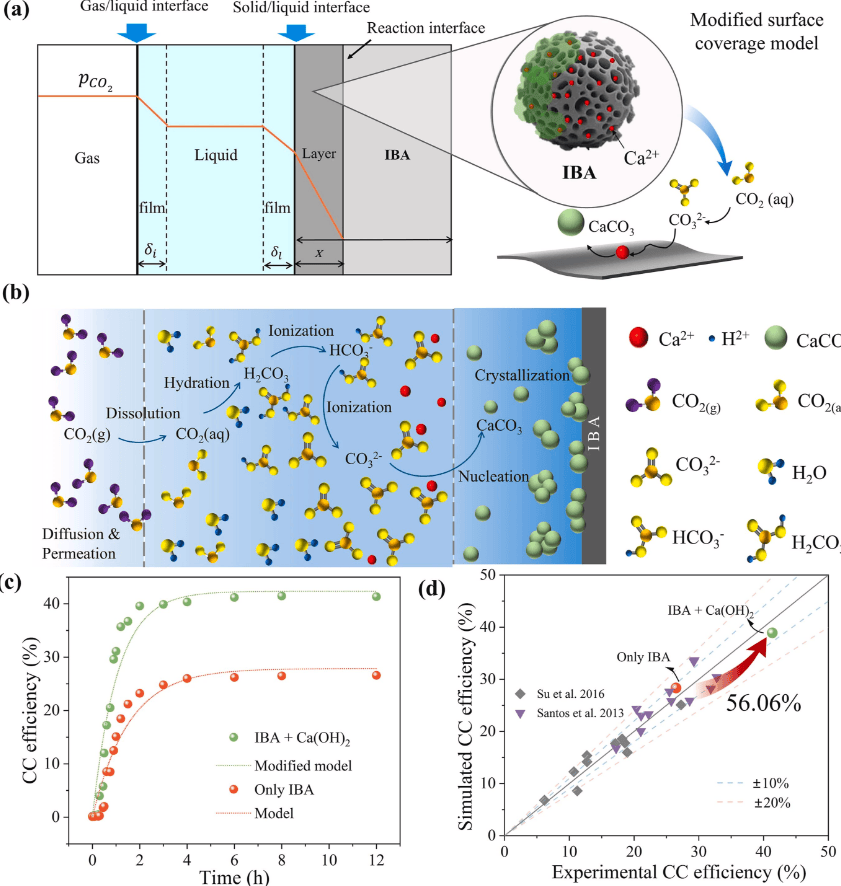
The research team focused on highly contaminated fine bottom ash with particle sizes less than 2 mm. By utilizing a liquid-phase carbonation reaction, they achieved in-situ growth of a CaCO₃ shell on the surface of bottom ash particles, constructing a CaCO₃@IBA core-shell structure. This technology achieves a CO₂ sequestration capacity of up to 246.45 mg/g IBA, with immobilization efficiencies of 90% for Zn, 49% for Cu, and 30% for chloride ions. By combining a modified surface coverage model, the study elucidated the reaction kinetics of carbonation coating and the formation mechanism of the core-shell structure. Leaching tests and molecular dynamics simulations revealed a triple synergistic immobilization mechanism for pollutants involving physical encapsulation, carbonate precipitation, and lattice coprecipitation.
Application performance verification demonstrated that when the CaCO₃@IBA aggregate was used as a replacement for natural sand at a 30% substitution rate, the compressive strength of the mortar increased by over 16% compared to mortar containing untreated bottom ash. The leaching values of pollutants from the hardened mortar met the limits specified in relevant building material regulations. The full industrial process design, based on a daily treatment capacity of 100 tons of incineration bottom ash, can simultaneously consume CO₂ from the waste incineration flue gas. A cost-benefit analysis conducted using Monte Carlo simulation showed an average net profit of 32.9 million euros over a 10-year project operation period, with a payback period of only 2.11 years. Life cycle assessment results indicated that each ton of product can achieve a reduction in global warming potential equivalent to 30.8 kg of CO₂.