
Scientists at the National Institute of Standards and Technology (NIST) have developed a new type of optical chip, the size of a fingernail, capable of producing a rainbow of various colored lasers. This chip manipulates light in a manner analogous to how traditional chips handle electrons, integrating lasers that emit multiple wavelengths into a tiny area, creating an optical "integrated circuit." This innovation is expected to inject new momentum into cutting-edge technologies such as artificial intelligence, quantum computing, and optical atomic clocks. The related paper was published in the latest issue of the journal Nature.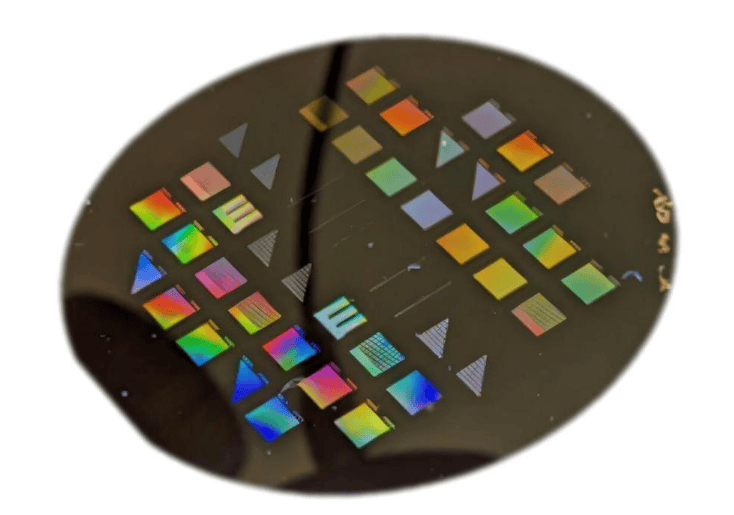
Currently, high-quality, compact, and efficient lasers often only emit a few specific wavelengths. For example, semiconductor lasers excel at producing 980-nanometer infrared light. However, technologies like optical atomic clocks and quantum computers require a diverse array of light sources. The traditional lasers capable of generating these colors are bulky, expensive, and consume significant power.
The newly developed photonic chip is akin to an intricate layer cake. The team started with a standard silicon wafer coated with silicon dioxide (glass) and lithium niobate—a nonlinear optical material that can change the color of light passing through it. They then added metal electrodes, applying electric fields to convert one color of light into another. The team also constructed other interfaces between metal and lithium niobate, enabling rapid switching and control of the light signals within the chip—a key capability for data processing and high-speed routing. The most fascinating "frosting" on this "cake" is a second nonlinear material, tantalum pentoxide. It possesses a kind of "magic": it can absorb a single color of laser light and "emit" a rainbow of multiple colors.
By three-dimensionally stacking different materials, the team created a photonic chip that allows light to efficiently flow between the layers. Each chip contains tens of thousands of photonic circuits, each capable of outputting a unique color.
Beyond applications in quantum computers and optical clocks, this photonic chip could also build high-speed channels for signal transmission between specialized chips, making AI tools increasingly powerful and efficient.