
Researchers at the University of Sharjah have published findings in the journal Construction and Building Materials, demonstrating that polymer sheets can replace steel reinforcement in concrete. The study is the first to systematically assess the structural performance differences between 3D-printed polylactic acid (PLA) sheets and steel bars in concrete reinforcement.
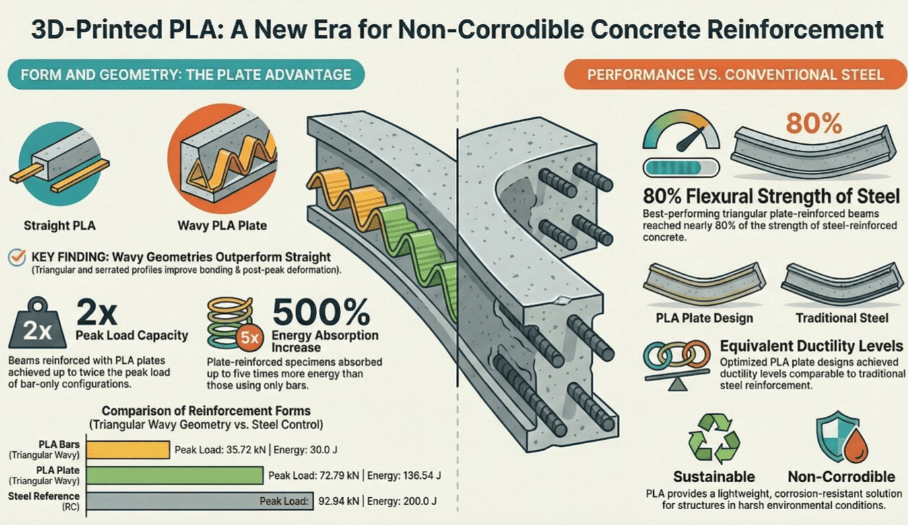
The study found that the peak load capacity of the polymer sheets was nearly twice that of the steel-reinforced structures, and their energy absorption was five times greater. The best-performing specimen achieved a flexural strength close to 80% of the steel-reinforced specimens. The research specifically noted that the geometry of the sheets significantly impacts structural performance—sheets outperformed rods, and triangular and corrugated shapes significantly improved the beam's ability to withstand post-cracking stress.

Dr. Mohammad Talha Junaid, Associate Professor of Materials and Structures at the University of Sharjah, stated that beams reinforced with PLA sheets exhibited twice the peak load capacity and five times the energy absorption of those with standard PLA rods. The larger surface area of the sheets provides stronger adhesion to the concrete. The most effective configuration was the triangular corrugated PLA sheet, which achieved nearly 80% of the flexural strength of traditional steel-reinforced beams, along with comparable ductility.
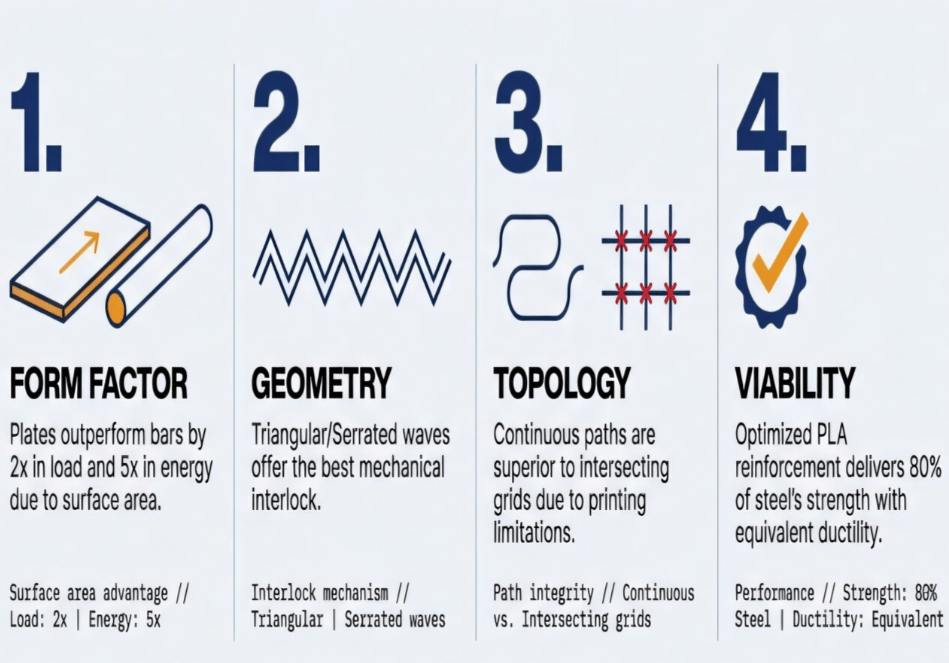
Dr. Junaid noted that while steel is effective, it has drawbacks such as heavy weight, high cost, and susceptibility to corrosion. Thermoplastic sheets offer advantages over traditional steel reinforcement, including corrosion resistance, lightweight properties, customizability, and sustainability. This research provides a pathway for mass-producing innovative reinforcement, demonstrating that the performance of reinforced concrete depends not only on the material itself but also on the geometry of the reinforcement.
More information: Authors: M. Talha Junaid et al., Title: "Flexural Characteristics of Small-Scale Beams Reinforced with 3D-Printed Polymer Rods and Sheets," published in *Construction and Building Materials* (2025).