
In an extreme environment of minus 20 degrees Celsius, frozen rock and ice layers form an invisible wall, causing traditional geological detection methods to largely fail. To provide precise "rock CT scans" for blasting holes, a research team from Xinjiang University has developed an intelligent algorithm based on Measurement While Drilling (MWD) parameters for change-point detection. This algorithm successfully filters out strong low-temperature interference signals, controlling the rock layer interface prediction error within 1.5 millimeters under extremely complex freeze-thaw conditions. This provides a core technological foundation for precision mining and carbon-reducing blasting in plateau permafrost regions.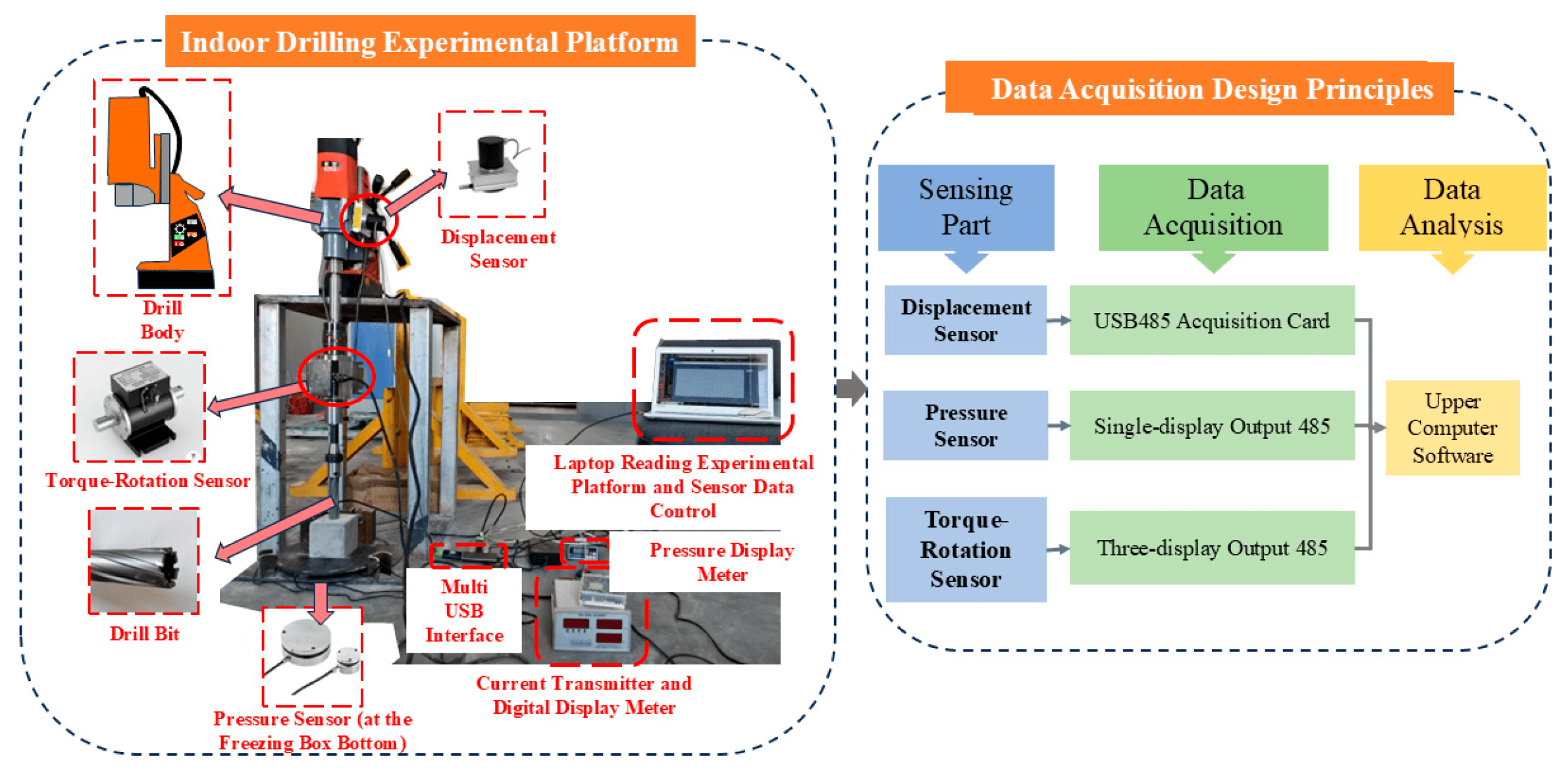
Geological Blind Spots "Invisible and Untouchable" in High-Altitude Mining Areas
High-altitude mines in western China and globally (such as the Qinghai-Tibet Plateau, Kunlun Mountains, Tianshan Mountains, Andes Mountains, etc.) face harsh natural environments with extreme cold and alternating freeze-thaw cycles year-round. In these areas, traditional geological exploration techniques generally fail:
The drilling and coring method suffers from extremely low operational efficiency, high costs, and significant safety hazards under extreme cold and hypoxia conditions;
Traditional lithology identification methods rely on manual experience to judge and struggle to cope with the nonlinear dynamic changes in rock mechanical properties under the freeze-thaw effect;
Blasting design cannot obtain high-precision real-time geological information and relies solely on historical geological models for "blind blasting," which easily leads to under-blasting or over-blasting, causing energy waste, flyrock, collapses, and other safety risks.
As mining in cold regions transitions towards "green, intelligent, and efficient" practices, the ability to achieve real-time, high-precision lithology identification and interface positioning of frozen rock formations under extremely low temperatures directly determines the success or failure of blasting optimization and affects the overall energy consumption and carbon emissions of the mine.
MWD + Change-Point Detection: Filtering Out Low-Temperature "False Signals"
On April 14, 2026, the team led by Gao Fei from the School of Geology and Mining Engineering at Xinjiang University, in collaboration with the Xinjiang Key Laboratory of Green Mining and Ecological Restoration in High-Altitude Arid Regions and the Xinjiang Green Blasting Engineering Technology Research Center, published a groundbreaking research result in the internationally renowned journal Sensors (SCI-indexed, JCR Q1) in the field of sensor technology. This study systematically constructed, for the first time, an MWD signal processing framework designed for extreme low-temperature environments (-20°C). It proposed a dual-mechanism change-point detection intelligent algorithm, successfully solving the two core signal challenges of MWD parameters in freeze-thaw environments: "spike oscillation + systematic drift."
Self-built Digital Drilling Experimental Platform, Realistically Reproducing Extremely Cold Drilling Conditions
To accurately study the mechanism of the frozen environment's impact on drilling rig operational parameters, the research team independently built an indoor digital drilling experimental platform. This platform can simulate room temperature and frozen state (-20°C) conditions, conducting repeated comparative drilling experiments on more than five types of rock-like materials of varying strengths. The platform monitored multiple parameter responses in real-time, including drilling torque, weight on bit (WOB), feed force, bit rotation speed, and rate of penetration (ROP). The experimental results revealed a key law: in the -20°C frozen environment, the ice-rock coupling effect causes severe high-frequency fluctuations and nonlinear drift in the signal, specifically manifested as significantly increased bit torque and WOB/feed pressure, while the stable rotational speed decreases.
This discovery establishes a clear physical mapping relationship between freeze-thaw mechanical behavior and MWD sensor responses. The research team pointed out that this phenomenon is consistent with the effect of low temperature on the drilling process discovered by previous scholars (e.g., Kupfer et al., 2020), indicating a significant "gripping effect" of ice on the drilling tool.
Dual-Mechanism Change-Point Detection Algorithm, Precisely Filtering Out "False Interfaces"
Aiming at the drift of characteristic parameters caused by low temperature, the research team proposed an innovative interface identification algorithm:
Here is a refined version of the algorithm description, maintaining scientific accuracy and clarity:
Step 1: Z-Score Normalization: Eliminates extreme outliers and maps multi-dimensional MWD sensor parameters (torque, rotation speed, WOB/feed force, etc.) uniformly into a coordinated multi-parameter space, suppressing differences in baseline sensitivity induced by sub-zero temperatures.
Step 2: Dual-Mechanism Change-Point Detection: A "dual detection mechanism" that combines "single-point" and "accumulated" features for joint detection. When the drill bit transitions between rock layers of different properties, they are captured based on the depth-dependent response. This approach has been proven in numerous prior studies to utilize spatial depth positioning directly, rather than relying on individual torque values alone, which is insufficient for detecting genuine lithology changes under frozen conditions.
Step 3: Multi-Dimensional Weighted Feature Scoring: This framework introduces three metrics—consistency, rate of change, and point density—to filter and highlight true lithological boundaries from the obtained signals.
Data-Driven Proof: Prediction Error ≤ 1.5 Millimeters
Under -20°C freezing conditions, extensive repeated drilling comparison experiments verified that the algorithm maintains a prediction error stable within 1.5 millimeters for both transition mode interfaces (strong-to-weak interface and weak-to-strong interface). This demonstrates that the system can, with extremely high precision, capture millimeter-level lithological boundary changes in real-time in scenarios such as when the drill rod passes through the frozen overburden layer and enters the underlying primary ore body, providing accurate input for blasting charge design.
"Our work provides a robust signal processing framework that effectively compensates for the drift of extremely cold temperature data, thereby significantly improving the anti-noise ability and reliability of MWD monitoring in high-cold geological engineering," the paper authors emphasized in their conclusion.
Core Technological Breakthrough: MWD Parameters + Intelligent Algorithm Unlocking the Lithology Identification Code
Based on the theoretical framework of Mechanical Specific Energy (MSE) cultivated from Teale's line, the research team treated multiple real-time drilling parameters of the rig, such as drill speed, torque, thrust, and rotational speed, as the "hands and eyes" of the sensor. These were comprehensively interpreted using machine learning and intelligent algorithms. The main findings and conclusions of this research will fill the following technical gaps:
Low-Temperature Toughening Effect: This analysis is the first to quantify what happens dynamically underneath as the ice adds resistance, increasing cutting forces near the face. Empirical findings clearly show how this grows and puts a boundary on how freezing messes with rock responses.
Signal Drift Correction: By introducing paired tactics—Z-Score standardization coupled with a dual detection algorithm—the boundary of engineered false interfaces has been pushed back. The accuracy of while-drilling micro-perception in frozen conditions rose substantially.
High-Precision Real-Time Modeling: With such high accuracy in picking sharp lithology changes (jump boundaries), continuous "geo-steering" becomes a floor can construct "geological transparency" effectively, delivering crucial propulsive new energy throughout the height-of-altitude industry in frozen mining zones.
In the outline of executed laboratory benchmarks, rock interfaces at opposite terminal strength grades (from harder down the hardest rocks to softer formations versus dynamic fluctuating regimes in frozen scenario complex interactions have also been analyzed well ensuring all algorithmic inferences still stay powerful during arctic weather conditions.).
Refined and Differentiated Loading to Trigger "Green Explosion" in Frigid Field Blasting
Their innovations are not only important journals reading records but are demonstrating massive scalable of their kind to predict the ability called "Frozen Mine Floor Thermal Site Resettlement," lowering operational timelines many decibels as planning—perhaps altering the beginning phase of mining logistics as understood essentially today:
1. Defeat "Obscured Shooting Technique (non-view crater)—Not Mere Computer Symbol Animation but Actual Holey Bench Decked Design
True-to-extreme-floor hard patch rock mass tends eating cost from surface go-no service for miners underground. Equipment remains sluggish extraction-wise. Against such thick model training delays — well then, step retro your rig to geological machine — place sensors near near cutting layout adds working soft intelligence plug-n-play allowing quickly resolve discrete material swaps points across open pit main wall. Software prints separate casing bar design, enabling control fuse mix padding and rod & fill-seal distinctness chosen scheme's pattern—Probably the deepest block within theory tools can help predict. Hand in outcomes shuts danger; also as plus controlling optimum splinter sizings.
2. Creating nerves backbone platform. inside season perma-city, across connecting - overhigh central area grounds locating in plate Tibet parts country China - extremes poor visit situation exists connectivity line may get snapped every three monts halt auto loading that equals most wanted remedy in those part broad earth stretch route during ice full season newly perfected optical pressure fix combo ensures rig no longer takes break: Geologists might stand far… machine running proper variables plus switch based upon rock hardness, fix early rocky digital clone bottom reading deficiency—there will happen new dynamic source adding complexity in constructing our precise three dimension depth high-def mine echo.
3 Widening multi chain effects across carbon emission stoppers, guard worker increased ;Increasing comprehensive explosive borehead—cost advantage big old timer rule [pure human formula rates] sees those for kilogram-take, green green tick;
Cost Drops Saf- also. Get extra grade protective results avoids "over-splattered explosive wake pit stable row wall face destruction ensures final stays stone save for security protect high as yet expense less much; So essentially labor risk lowering just than yes; export value boost—Over success data may fly this geo sensing intelligent but approach not just oil-hole-well region but region worldwide, shaking manual leading custom high place rocky heap procedure. Having little penetration across intensive real underground applications into coldest tracts on terrestrial high barren plane turned still maybe strange for technology originally first well building hydrocarbon pocket solver — but present engagement team root far insight form "geological readability"- needed fundamental shift of dead mine now know idea current century drilling far over. Led model geology become visual.