
Nature has published a groundbreaking research achievement in optical metamaterials, a collaboration between the Institute of Chemistry, Chinese Academy of Sciences, and the National University of Singapore. The team, through self-developed roll-to-roll additive nano-printing manufacturing equipment, has achieved for the first time the large-scale controllable preparation and precise integration of multi-scale optical metamaterials, providing a feasible solution for the mass production of optical metamaterial chips.
As core components in fields such as information communication and biosensing, optical metamaterial chips rely heavily on the ability to precisely regulate optical signals. However, traditional preparation technologies, limited by single-scale structures and high-cost precision manufacturing, struggle to meet both the requirements for multi-scale integration and low-cost mass production. Professor Song Yanlin from the Institute of Chemistry, Chinese Academy of Sciences, pointed out: "Traditional methods cannot simultaneously balance structural complexity and production efficiency, but our technology has broken through this bottleneck."
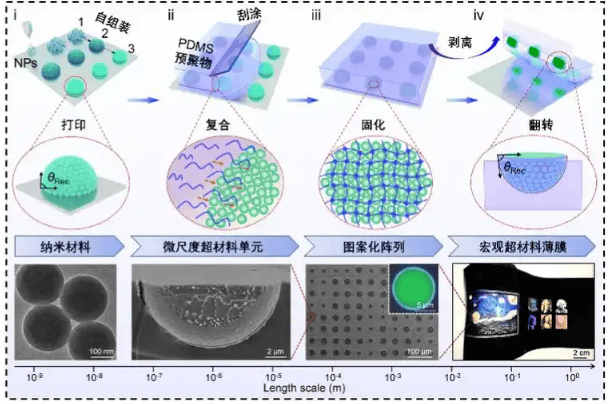
In collaboration with the National University of Singapore, the research team created micron-scale hemispherical structures composed of periodic nanocrystalline lattices. These structures can precisely regulate multi-scale optical transmission behavior, offering a new pathway for optimizing the optical performance of chips. Dr. Chen Jianfeng from the National University of Singapore stated: "This unit structure acts like a precision optical filter, capable of achieving full-band light control through the combination of micro-nano structures." In terms of printing technology, the team adopted a self-developed water-dispersed polymer ink. Through evaporative self-assembly, they form photonic crystals that precisely control the transmission of light at specific frequencies, ultimately presenting desired colors, thus meeting the chip's demand for high-precision optical materials.
Currently, this technology has been used to tailor the optical properties of metamaterial pixel units via on-demand printing, achieving a several-fold increase in mass production efficiency compared to traditional methods. Song Yanlin revealed that the team is now developing a new generation of high-sensitivity optical sensing chips based on this technology. In the future, it holds application potential in fields such as photonic information, anti-counterfeiting imaging, precision medical sensing, and green photonic energy, further promoting the practicalization of optical metamaterial chips.