
A team led by Wan-Yi Nie, Associate Professor of Physics at the University at Buffalo, and Da-Xian Cai, Assistant Professor of Chemical and Biological Engineering, has recently published research findings in *Nature Communications*, successfully developing a novel chiral semiconductor material. By chemically combining a chiral perovskite semiconductor with the organic dopant molecule F4TCNQ, this material achieves efficient absorption of visible light while retaining the ability to distinguish left- and right-handed circularly polarized light, offering new possibilities for optoelectronic technology.
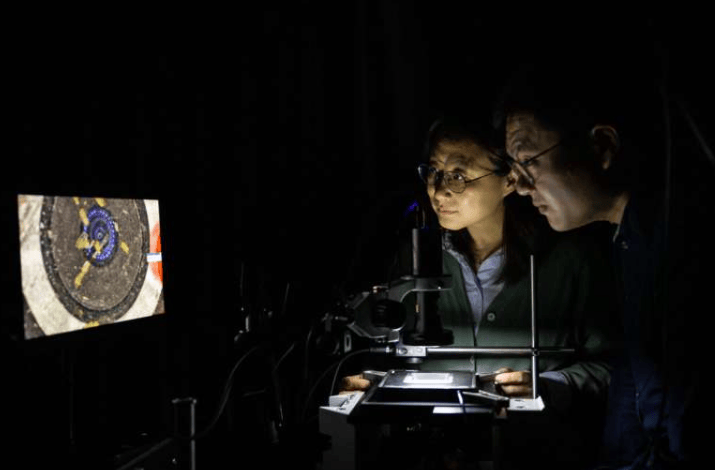
Chiral molecules possess a property that prevents them from being superimposed on their mirror images, much like left and right hands. Many biological molecules, such as DNA, exhibit chiral structures. In the semiconductor field, chiral crystal structures can differentiate between left- and right-handed circularly polarized light. However, most chiral semiconductors, due to their wide band gaps, primarily absorb high-energy ultraviolet light and respond weakly to visible light. By combining the chiral semiconductor with F4TCNQ and leveraging an electron transfer mechanism, Nie's team enabled the material to form a charge transfer state under visible light irradiation, thereby efficiently absorbing visible light. "We successfully transferred the chiral characteristics to a non-chiral molecule," Nie stated. "The resulting material retains the inertia of the chiral semiconductor while gaining the ability to respond to visible light."
Cai likened this process to an assist in basketball: "The chiral molecule is the guard, and the dopant molecule is the forward. The guard reads the play and passes the ball to the forward to score." The research team's next step is to delve into the physical mechanism driving the transfer of chiral properties to further optimize the material's performance. Currently, this achievement has attracted interest from multiple institutions, including Los Alamos National Laboratory and Brookhaven National Laboratory. Potential applications include polarized light sensors, optical communication systems, and photocatalytic technologies.
Publication details: Authors: Guan-Lin Chen et al., Title: 'Transmission of Chirality from Perovskites to Molecular Dopants via Charge Transfer States', Published in: *Nature Communications* (2026), Journal: Nature Communications