
Recently, the pile foundations for the main piers of the Changsha Xiangjiang River Mega Bridge on the Changsha-Ganzhou High-Speed Railway, constructed by China Railway Major Bridge Engineering Group under the development of China Railway Guangzhou Group and Shanghai-Kunming Passenger Dedicated Line Hunan Company, have been completed successively, marking the start of the pile cap construction phase. Located in Hunan Province, China, the bridge has a total length of 768.1 meters and is a controlling project for the Hunan section of the Changsha-Ganzhou High-Speed Railway. The main bridge adopts a cable-stayed bridge design to span the main navigation channel of the right branch of the Xiangjiang River.
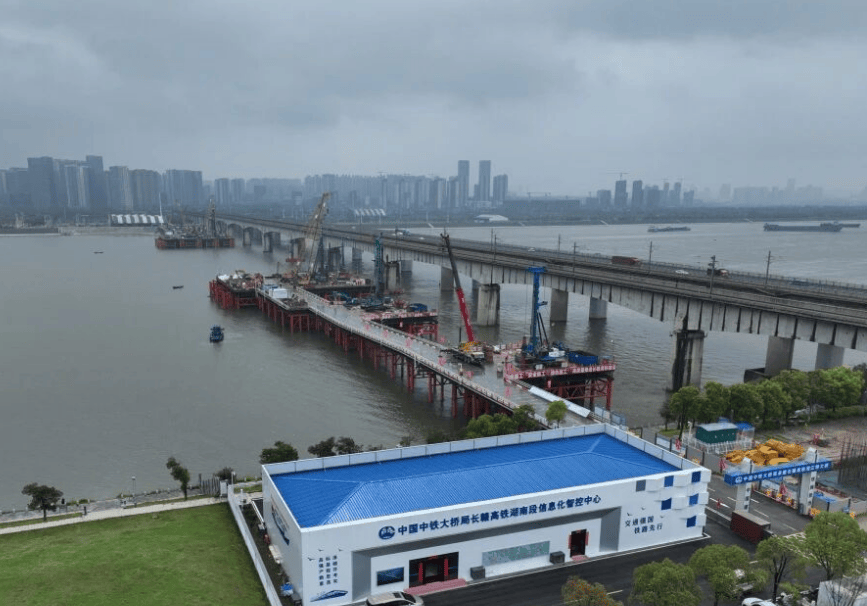
The Changsha Xiangjiang River Mega Bridge is in close proximity to the existing Shimen-Changsha Railway, with a minimum clearance of only 15.57 meters. The project department has installed an existing line deformation monitoring system in the construction area adjacent to the operating line, implementing 24-hour tracking and monitoring. Should abnormal data from bridge piers or rails exceed limits, early warning messages are immediately pushed. Train approach warning equipment has been installed approximately two kilometers from the site, automatically broadcasting alerts through loudspeakers when a train approaches. The system integrates AI intelligent video technology to locate personnel and machinery within the work area. LiDAR monitors whether personnel and machinery cross boundaries at key locations such as the trestle bridge and main pier platforms in real time. The intelligent supervision platform for over-water operations integrates the trestle, ships, and vehicles into unified monitoring, using satellite positioning systems to monitor trestle settlement, underwater depth sounder sensors to observe water flow scouring on steel pipe piles, and a ship collision avoidance detection system that combines AIS and infrared sensing technology to track vessel position, speed, and heading in real time.
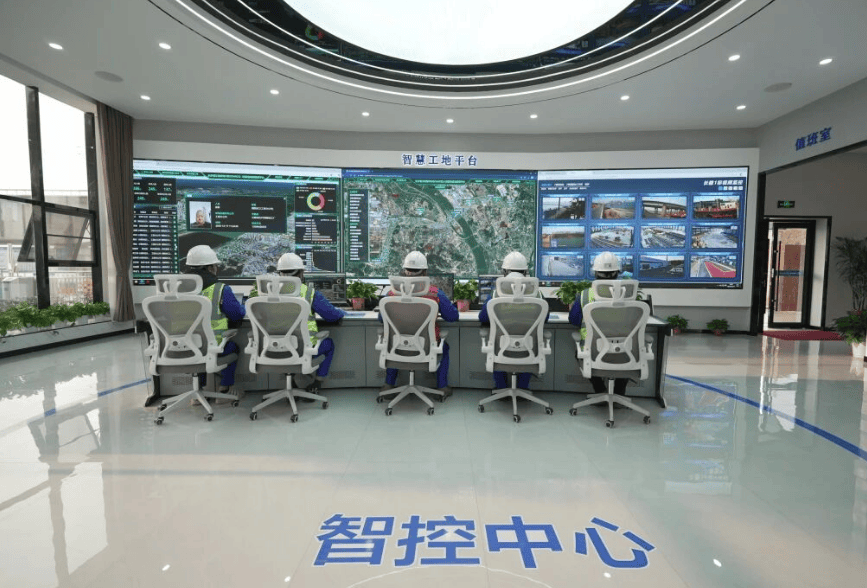
In terms of intelligent bridge construction, an intelligent temperature control system for mass concrete monitors temperature in real time and automatically adjusts cooling water flow. The main tower climbing formwork achieves automatic leveling and curing. Steel girder segment lifting is monitored via sensors for hoisting posture, and intelligent T-structure rotation technology precisely monitors rotation angle and distance. The project department has also established a "cloud factory" for intelligent steel bar production, replacing traditional manual detailing with intelligent detailing software. An IoT remote processing system sends processing instructions directly from the cloud to CNC equipment with a single click. Meteorological and water quality monitoring stations deployed along the river monitor dust, noise, and water quality indicators in real time. Relying on a BIM platform, a big data traceability system has been established, achieving full lifecycle traceability for raw materials, concrete, steel bar processing, and concealed works.
Guo Xidong, Project Manager of the Changsha-Ganzhou High-Speed Railway for China Railway Major Bridge Engineering Group, stated: "The project department will continue to advance the application of intelligent construction technologies, using innovation to enhance quality and efficiency, and strive to build a high-quality, exemplary project, providing a practical model for the high-quality development of China's high-speed railways and the intelligent upgrading of bridge construction." Upon completion and opening of the Changsha-Ganzhou High-Speed Railway, the railway network structure in the Hunan-Jiangxi border region and along the line will be further optimized, continuously strengthening the connection between the central region and the southeastern coastal areas.