
In traditional magnetic separation processes for low-grade magnetite, coarse ore particles often carry a large amount of tailings, leading to poor separation results. A significant quantity of mixed waste rock is fed into the subsequent high-energy-consumption grinding stage, causing enormous resource waste. Now, this long-standing challenge in the mineral processing field is being overcome by a new sensor-based intelligent identification system. By fusing Empirical Mode Decomposition (EMD) with a Convolutional Neural Network (CNN), this solution performs precise noise reduction and intelligent classification of magnetic induction signals, achieving efficient pre-concentration of coarse, low-grade magnetite and opening a new channel for the intelligent transformation of traditional mineral processing techniques.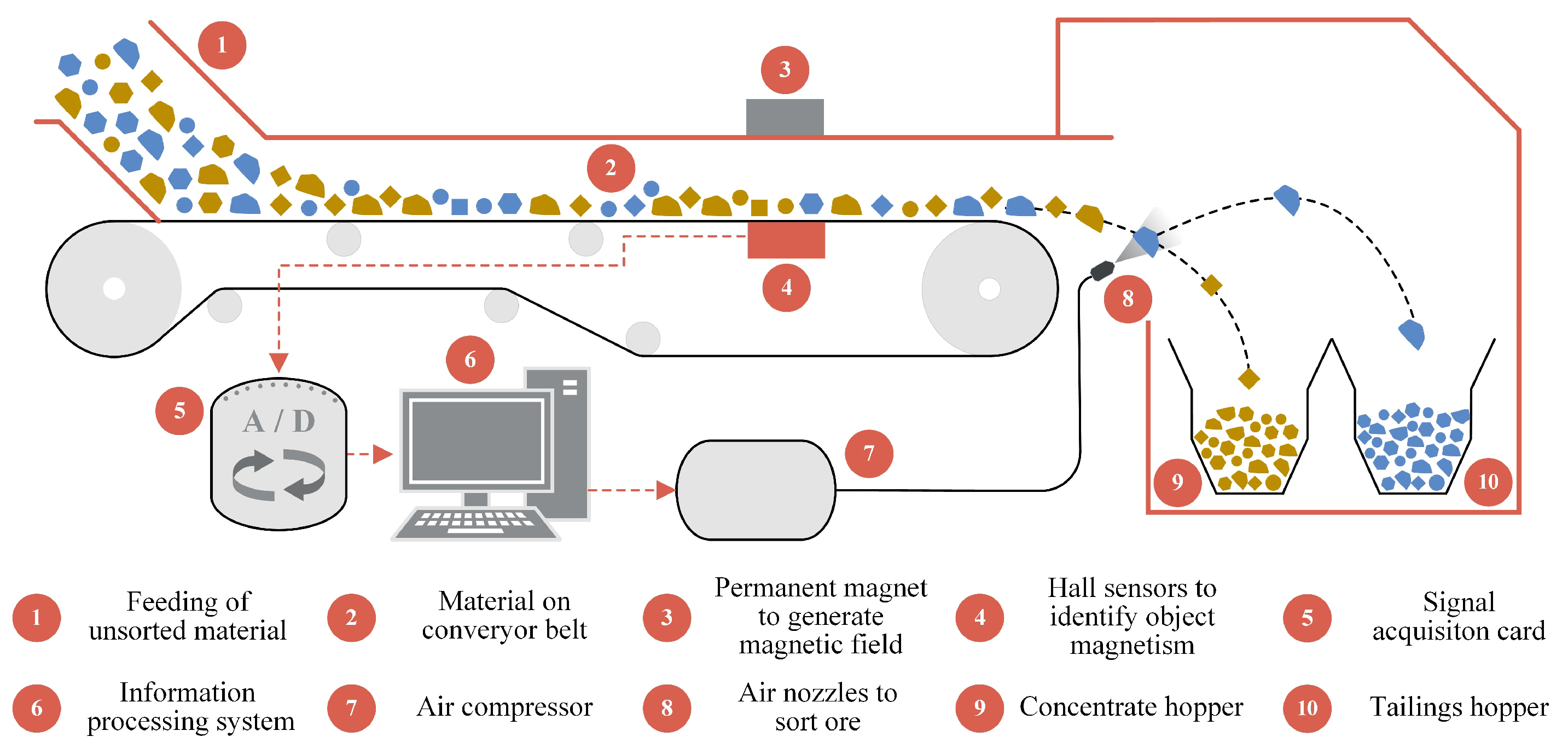
The "Signal Deafness" Dilemma in Coarse Particle Ore Sorting
Magnetite pre-concentration is the first critical step for "discarding tailings and upgrading quality" in a processing plant, and its effectiveness directly determines the feed volume for subsequent grinding and flotation operations and the overall energy consumption. However, low-grade magnetite ores contain high levels of gangue minerals and coarse particles. The difference in magnetic induction signals between ore and waste rock is extremely weak and susceptible to the superimposed effects of sensor baseline drift, electromagnetic interference, and impulse noise. This leads to a significant reduction in the signal-to-noise ratio, with useful characteristic information submerged in redundant noise.
Furthermore, when coarse ore particles pass through the sensor's induction zone, their unstable motion posture complicates the modulation of the output signal. Traditional equipment relies on fixed thresholds for discrimination, making it difficult to capture dynamic differences between individual ore particles. This results in low classification accuracy and high variability, failing to meet the process requirements for precise pre-concentration. Faced with the scenario of large-scale coarse particle waste rock discarding, traditional sorting solutions are neither intelligent nor efficient, directly constraining the comprehensive utilization level of low-grade iron ore resources.
A Full-Chain Breakthrough from Signal Reconstruction to End-to-End Intelligent Classification
To address these issues, a research team including Ren Yankui from multiple universities such as Jiuquan Vocational and Technical University, University of Science and Technology Beijing, Hubei University of Technology, Jiangxi University of Science and Technology, and Nanchang Hangkong University, published a research paper in the international mainstream journal Minerals in the field of mineralogy. The paper systematically proposes a magnetite sensor sorting method integrating EMD and CNN, covering the complete technical chain from pre-processing to classification prediction. Its core innovations are mainly reflected in three aspects.
First, in the signal pre-processing stage, multi-element adaptive noise reduction is achieved. The raw collected magnetic induction signals first undergo standardization processing, effectively suppressing sensor baseline drift and establishing a stable data foundation for subsequent processing. Subsequently, the Empirical Mode Decomposition (EMD) method is introduced, which can adaptively decompose non-stationary noise signals into a series of Intrinsic Mode Functions (IMFs) without pre-setting basis functions. The research team conducted a comprehensive quantitative evaluation based on the scaling exponent and kurtosis value of the IMFs, selectively removing components dominated by high-frequency noise, retaining effective components containing ore-related information, and reconstructing them, thereby significantly improving the signal-to-noise ratio of the reconstructed signal.
Second, in the feature extraction and signal-to-information conversion stage, a CNN-friendly representation is constructed. The reconstructed signal after EMD denoising undergoes absolute value processing to retain amplitude information, followed by normalization and dimension transformation, converting the one-dimensional sensor sequence into a two-dimensional matrix format. This maps the subtle differences between ore and rock in the original signal into graphical patterns easily captured by the CNN. This method effectively bypasses the limitations of traditional manual feature selection, achieving intelligent translation from raw signals to inputs understandable by deep learning.
Finally, at the classification prediction level, end-to-end automatic recognition by CNN is realized. The research team designed and optimized a convolutional neural network tailored for the pre-concentration task. The pre-processed feature samples are automatically fed into the CNN for deep feature extraction and hierarchical abstraction, separating the essential differences between valuable minerals and waste rock. Experimental results show that, supported by standardization processing and EMD denoising, the CNN's ability to identify different grades of magnetite steadily improves, successfully achieving stable and controlled accuracy across ore grades. This provides a completely new intelligent solution for the efficient pre-concentration of low-grade coarse particle ores.
Starting from the Sorting Unit to Leverage Cost Reduction and Efficiency Improvement Across the Entire Mineral Processing Flow
This multi-strategy integrated sensor sorting solution has significant engineering promotion value and broad application prospects. In terms of efficient utilization of low-grade mineral resources, a large amount of low-grade magnetite and iron-bearing waste rock in China has been long abandoned due to the difficulty of tailings discarding and high re-processing costs using traditional processes. This system can be deployed after the crushing stage and before the grinding stage, intercepting approximately 30%-50% of the waste rock yield at an extremely low energy cost. This significantly reduces the amount of ore entering the grinding mill, lowers grinding energy consumption, steel consumption, and tailings discharge volume, effectively unlocking the economically recoverable value of low-grade resources.
Regarding the unmanned construction of complex mines, this system is expected to accelerate the establishment of an operational chain of sensor sorting-online identification-immediate waste discarding underground or on the surface. It fundamentally eliminates reliance on manual monitoring, supports reliable unmanned operation of processing plants in harsh environments, and provides a solid technological foundation for intelligent mine construction. Furthermore, the EMD and CNN fusion framework possesses high generalization capability and can be rapidly transferred to the pre-concentration scenarios of other low-grade ores based on electromagnetic or photoelectric signal differences, such as phosphate, tungsten, and lead-zinc ores. This lays the foundation for exploring the establishment of a unified "intelligent sensor sorting model" and promotes the iterative implementation of the differentiated sorting strategy of "coarse particle pre-concentration - fine grinding - precise enrichment."
Defining the "Intelligent Gene" of Sensor-Based Ore Sorting
The fundamental value of this research lies in the organic integration of cutting-edge signal processing technology with a dynamic adaptive deep learning model, providing an end-to-end deep solution to the long-standing problems of "severe signal contamination and prominent bottlenecks in manual feature engineering" in the mineral processing field. The combined use of Empirical Mode Decomposition (EMD) and Convolutional Neural Network (CNN) enables equipment to shift from passively comparing signals to actively mining effective features, endowing sensor-based ore sorting with the leap-forward intelligence to move from "hearing" to "understanding."
When signal denoising moves from fixed filtering to adaptive decomposition, and classification decisions shift from manual parameter tuning to automatic CNN mining, the technological inflection point for sensor-based ore sorting has arrived. This is not a simple equipment iteration, but a systemic breakthrough resulting from the deep integration of three domains: sensors, signal processing, and deep learning. It marks a crucial step forward for China in the field of intelligent sorting of low-grade iron ore, injecting new hardcore momentum into the digital transformation and green, efficient development of the mining industry.