
A research team led by Dr. Nam Ki-hoon at the Battery Materials and Process Research Center of the Korea Electrotechnology Research Institute (KERI) has successfully developed a nano-tin interlayer control technology. This innovation aims to solve the interfacial instability between the lithium metal anode and the solid electrolyte in all-solid-state batteries, which is one of the core obstacles to their commercialization. The research findings were published in the journal Advanced Energy Materials.
All-solid-state batteries have garnered attention because their fire risk is significantly lower than that of traditional liquid electrolyte batteries. By using lithium metal to replace the conventional graphite anode, their energy density can be improved, but technical challenges arising from interfacial contact remain prominent. Unstable physical contact between the solid electrolyte and electrode materials hinders efficient ion transport, and the dendritic structures formed by lithium metal during repeated charge-discharge cycles further shorten battery life.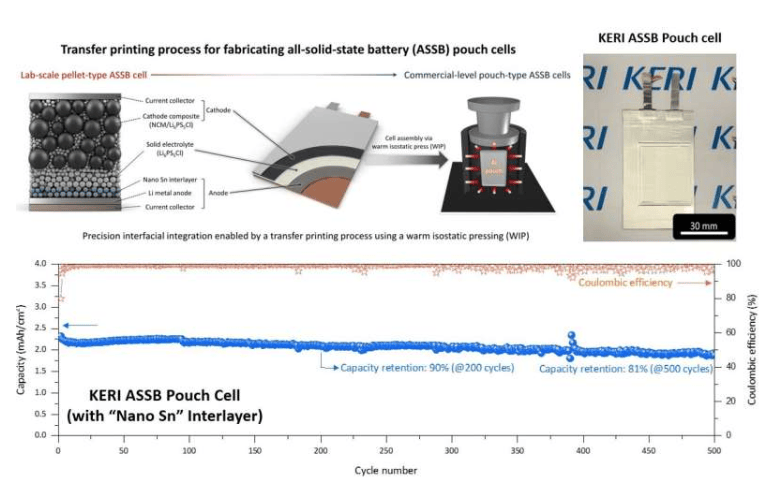
Previously, laboratories typically relied on applying high external pressure of tens of megapascals or employing complex coating processes to stabilize the interface. When high-pressure systems are applied to practical devices like electric vehicles, the weight of the pressurization device itself can exceed that of the battery, leading to increased manufacturing costs and reduced space utilization efficiency, thus constraining large-scale application.
The nano-tin thin interlayer developed by the KERI team is directly imprinted onto the surface of the lithium metal anode using a transfer printing process. This interlayer reduces interfacial resistance, mitigates physical damage to the lithium metal, and acts as an ion transport channel. The research team tested this technology on pouch cells, and under a low pressure of just 2 megapascals, the capacity retention rate remained over 81% after 500 cycles, with an energy density exceeding 350 watt-hours per kilogram, surpassing the typical range of 150 to 250 watt-hours per kilogram for conventional lithium-ion batteries.
Dr. Nam Ki-hoon stated, "This research is significant because it ensures both the large-area scalability and interfacial stability required for the commercialization of all-solid-state batteries, while also proposing a practical solution." Project leader Dr. Ha Yoon-cheol noted, "All-solid-state batteries are a core area of battery technology competition, and this achievement represents progress made in technological independence and competitive advantage."
The research was conducted in collaboration with Dr. Kim Young-woo of the Korea Institute of Energy Research, where the team used first-principles calculation simulations to elucidate the mechanism by which tin-based alloys regulate lithium-ion transport at the atomic and electronic structure levels.