
A joint research team led by Professor Choe Yang-gyu and Professor Kim Sang-hyun from the School of Electrical Engineering at the Korea Advanced Institute of Science and Technology (KAIST) recently published their findings in Science Advances, announcing the successful development of an oscillatory Ising machine based on traditional silicon semiconductor processes. The device achieves rapid solving of combinatorial optimization problems through multi-oscillator synchronization, applicable to fields such as logistics route planning, financial portfolio construction, and semiconductor circuit design, providing a viable solution for deploying specialized optimization hardware directly on existing manufacturing lines.
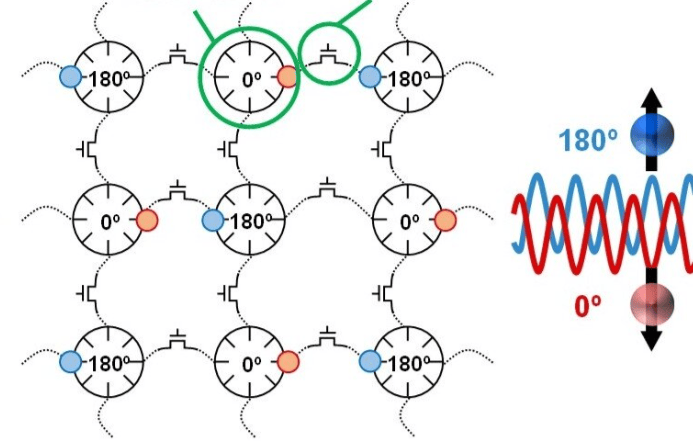
The research team focused on periodic electrical signal oscillators, integrating the oscillator and coupler through a single silicon transistor, significantly reducing frequency deviation between components and enhancing connectivity. In experiments, the device successfully solved the Max-Cut problem—a typical combinatorial optimization problem that involves dividing a network into two groups to maximize the number of connections. Professor Choe Yang-gyu noted: "Traditional methods rely on precisely controlling the frequency difference of oscillators, whereas our technology achieves multi-level coupling through silicon-based processes, enabling more accurate reflection of problem weights and significantly improving solution search efficiency."
The core advantage of this hardware lies in its compatibility with CMOS processes, requiring no special materials or non-standard production lines, allowing for direct mass production in existing semiconductor factories. The research team emphasized that this feature will accelerate the technology's transition from laboratory to industrial scenarios, with significant potential particularly in areas requiring large-scale combinatorial optimization, such as semiconductor design automation and communication network optimization. Professor Kim Sang-hyun added: "As transistor miniaturization approaches physical limits, exploring new functionalities becomes crucial. This research validates a third functional paradigm for transistors as oscillators, providing a new direction for future hardware design."
From a historical perspective, transistor technology has gone through two major phases—switches and amplifiers—and this breakthrough is defined as the "third wave": the transistor as an oscillator. This paradigm shift not only expands the application boundaries of semiconductors but also provides hardware support for low-power, high-real-time optimization tasks in the information and communication field.
Publication Details: Authors: Seong-Yun Yun et al., Title: A scalable Ising machine composed entirely of silicon transistors, Published in: Science Advances (2026), Journal Information: Science Advances