
Since the Bronze Age, traditional iron and steel metallurgy has consistently followed the centuries-old, multi-stage chain of "ore → sintering → blast furnace ironmaking → converter steelmaking → ingot casting → hot rolling/cold rolling → machining." This not only dictates the ultra-high carbon footprint of the global steel industry, which emits approximately 3.6 billion tonnes of CO₂ annually, but also means that the journey from ore to final part takes weeks to months. Now, this millennia-old route has been completely rewritten—an international team has jointly demonstrated the possibility of "direct additive manufacturing of parts from ore," compressing the stainless steel preparation pathway into a single step for the first time.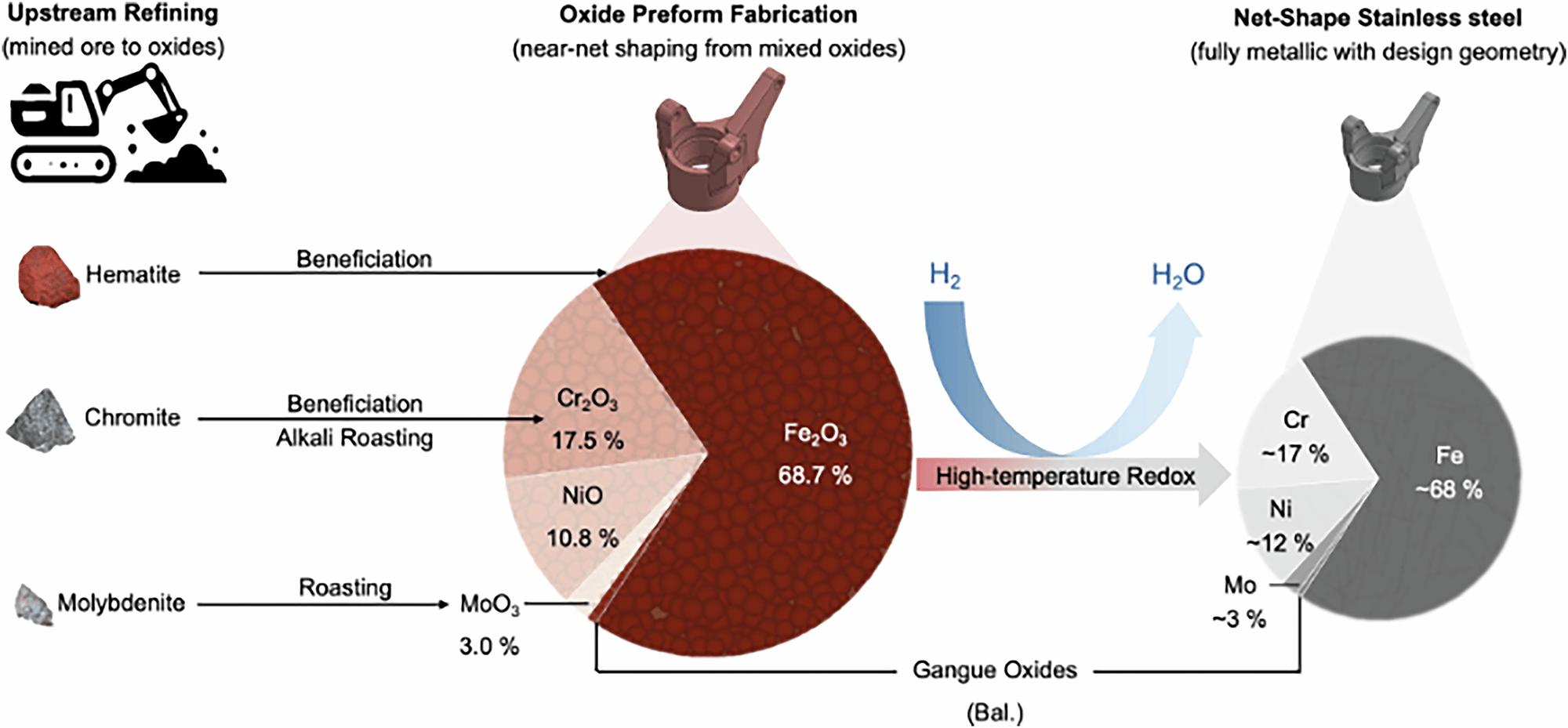
One-Step Forming: From Mixed Oxides Directly to Near-Net-Shape Stainless Steel Parts
Recently, an international collaboration team including the National Engineering Research Center for Vacuum Metallurgy at Kunming University of Science and Technology, China, and the University of Utah, USA, published a breakthrough study in the journal npj Advanced Manufacturing, part of the Nature Portfolio. The paper is titled "Hydrogen-based ore-to-part manufacturing of near-net-shape stainless steel."
The research team used a mixed oxide powder of Fe₂O₃, Cr₂O₃, NiO, and MoO₄ as raw material. Through additive manufacturing combined with hydrogen sintering, they achieved complete in-situ reduction of all components—from iron, chromium, nickel, and molybdenum to molybdenum oxide—at 1300°C, obtaining a dense, crack-free bulk alloy and enabling the direct fabrication of near-net-shape austenitic stainless steel parts. This marks the world's first successful demonstration of directly near-net-shaping metal parts from ore.
Technical Validation: A Dual Breakthrough in Dense Alloys and Chromium-Molybdenum Reduction
The core challenge of this technology lies in the significant differences in reduction temperatures and kinetics among the various alloying elements (particularly chromium and molybdenum) within the oxides. The approximately 18% chromium content in austenitic stainless steel relies on the complete reduction of chromium oxide (Cr₂O₃), which is difficult to achieve under conventional hydrogen reduction conditions. Through thermodynamic calculations, the research team elucidated the co-reduction mechanism and alloying pathway, demonstrating that synergistic effects between the oxides can shift the reduction temperature toward a lower window, enabling the uniform distribution of chromium and molybdenum within the part. After sintering, the parts maintained geometric precision while undergoing reasonable volumetric shrinkage, proving the feasibility of this process from oxide mixing to a dense alloy.
How It Disrupts Steelmaking: Completely Bypassing the Three Long Chains of Blast Furnace-Converter-Hot Rolling
Traditional stainless steel manufacturing encompasses over ten stages, including mining, sintering, blast furnace ironmaking, converter steelmaking, refining, continuous casting, hot rolling, cold rolling, and part machining. The total time required ranges from weeks to months, carbon emissions exceed 2 tonnes of CO₂ per tonne of steel, and energy consumption accounts for about 8% of the global total. The hydrogen-based "ore-to-part" technology utilizes hydrogen's reducing capability to process ore while simultaneously shaping the steel into a near-net geometry during the hydrogen reduction sintering process. This effectively bypasses multiple energy-intensive intermediate steps, drastically reducing carbon emissions to approximately 0.2 tonnes of CO₂ per tonne of steel—a reduction of about 90% compared to the traditional process—and virtually eliminating sulfur oxide, nitrogen oxide, and dust emissions. Furthermore, by eliminating casting, hot rolling, and machining, the manufacturing cycle is expected to be shortened by over 80%, making distributed, on-demand manufacturing possible.
From Marine Engineering to Aerospace
This process holds disruptive application potential in multiple high-end manufacturing sectors requiring complex shapes and high-corrosion-resistance stainless steel parts. In scenarios such as high-temperature structural components for aerospace and pressure-resistant hulls for marine engineering, this technology can bypass traditional casting and hot rolling processes to directly form customized, high-performance components. In fields like high-end medical implants and micro-reactors, this technology enables the rapid iteration of specific nickel-based or chromium-based alloys, significantly shortening clinical translation cycles. With the integration of process monitoring systems, real-time spectroscopy, and AI-driven optimization, this method has already demonstrated a solid foundation for scaling up to industrial applications.
Reshaping the Global Stainless Steel Supply Chain Landscape
This breakthrough not only redefines the starting point of metal part manufacturing on a technical level but also has the potential to fundamentally reshape the global stainless steel supply chain landscape. The traditional steel industry is highly dependent on high-grade ores from specific mining areas, concentrated large-scale smelting capacity, and globalized logistics networks for hot-rolled coils. Once the "ore-direct-to-part" technology expands to large-scale application, the positioning of manufacturing centers may shift from "proximity to blast furnaces and ports" to "proximity to additive manufacturing capabilities," forming shorter, more agile distributed manufacturing networks.
As a primary participating institution, the School of Materials Science and Engineering at Kunming University of Science and Technology, leveraging the profound expertise of the National Engineering Research Center for Vacuum Metallurgy in this field, provided key technical support for this breakthrough. As the paper states, this technology can "minimize emissions and lead times associated with downstream processing (such as rolling, forging, and machining), opening a new pathway for decarbonized steel manufacturing." With the continuous expansion of the hydrogen economy, green hydrogen produced using renewable energy will more closely integrate metallurgy with clean energy systems, moving "full-lifecycle near-zero-carbon stainless steel parts" from the laboratory into reality.