
The SARCOS (Steel and Recycled Concrete Composite Slabs) project, jointly conducted by the University of Cagliari and the Polytechnic University of Milan in Italy, has recently published research findings demonstrating that recycled concrete composite slabs made from recovered materials perform comparably to traditional products, and in some cases even outperform them. The results have been published in the journal Materials and Structures.
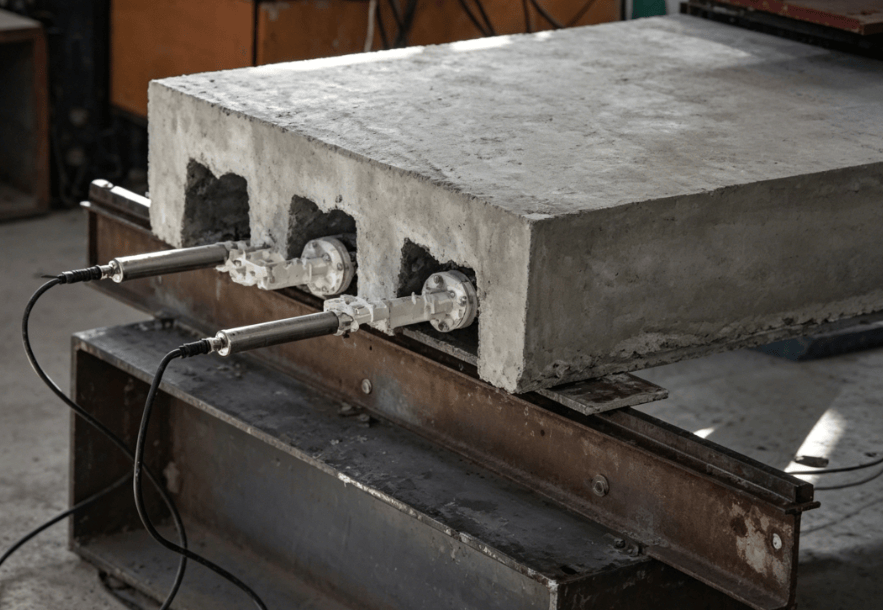
The core concept of the project is to replace natural aggregates in concrete with rubble generated from building demolition, reducing dependence on natural resources through a circular economy model. Researchers combined different proportions of recycled concrete (ranging from 30% to 100%) with high-strength profiled steel sheets to create composite slabs and conducted tests on full-scale specimens.
Professor Flavio Stochino from the Department of Civil, Environmental and Architectural Engineering at the University of Cagliari stated: "Concrete made with recycled materials may exhibit lower performance than traditional concrete, depending on its production method. However, our project has demonstrated through full-scale testing that in composite slabs, its performance remains unchanged and, in some cases, even improves." The entire solution is designed with complete recyclability in mind—besides the concrete, the steel can also be melted down and reused at the next construction site.
Researcher Marco Simoncelli from the Department of Architecture, Built Environment and Construction Engineering at the Polytechnic University of Milan pointed out: "The sand used in construction does not come from deserts, but from rivers or alluvial quarries. Therefore, using rubble from demolished buildings to replace sand can avoid further excavation and help preserve the original natural environment."
More information: Authors: Marco Simoncelli et al., Title: "Finite Element Modelling of Composite Slabs with Recycled Concrete Aggregates: Collapse Mechanisms and Interface Behaviour", Published in: Materials and Structures (2025).