
A research team from the National University of Singapore (NUS) has recently developed a single-atom platinum catalyst capable of igniting ammonia gas at a low temperature of approximately 215°C and maintaining stable combustion at a high temperature of 1100°C, while keeping nitrogen oxide emissions at extremely low levels. This achievement offers a potential carbon-free thermal energy solution for high-emission industries such as steel, cement, and chemicals. The related research has been published in the academic journal *Joule*.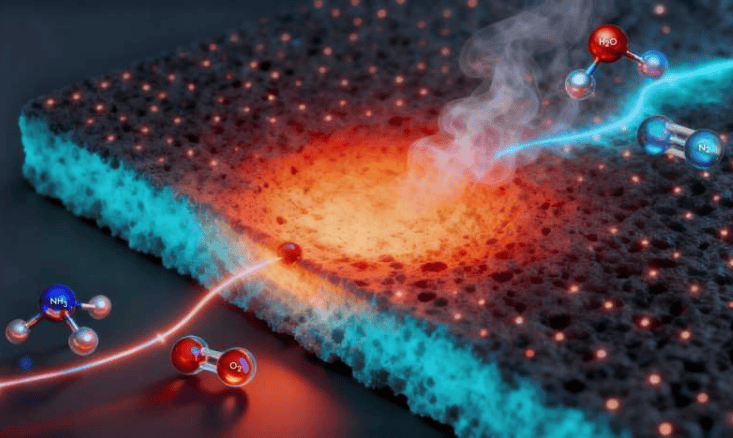
Ammonia, as a carbon-free fuel, can be synthesized from air, water, and renewable electricity, and is easily stored and transported in liquid form. However, ammonia combustion suffers from inherent drawbacks such as high ignition temperature, slow flame speed, and the tendency to generate nitrogen oxides at high temperatures, making it difficult for heavy industries to adopt it as an alternative fuel. The research team, jointly led by Professor Ning Yan from the Department of Chemical and Biomolecular Engineering and Assistant Professor Qian He from the Department of Materials Science and Engineering at NUS, proposed a "high-temperature catalytic ammonia combustion" technical route, using an atomically designed catalyst to solve the aforementioned challenges.
The research team dispersed and anchored single platinum atoms onto a zirconia-reinforced alumina support. This structure prevents the metal atoms from aggregating at high temperatures, allowing the catalyst to maintain structural stability in environments exceeding 1000°C. Laboratory tests showed that the catalyst can ignite ammonia at approximately 215°C, far below the conventional combustion requirement of over 500°C, and operated continuously for over 80 hours at 1100°C, achieving complete conversion of ammonia molecules with nitrogen oxide emissions of only about 50 ppm.
Assistant Professor Qian He stated: "Heavy industries need high-quality thermal energy, not just clean exhaust. Our goal is to kill two birds with one stone: to make ammonia easier to ignite while keeping nitrogen oxide emissions low during high-temperature operation." Yankun Du, the first author of the paper, pointed out: "Ammonia has long been seen as a promising low-carbon fuel, but realizing its application requires solving a long-standing chemical puzzle. Our catalyst shows that it is possible to release ammonia's energy cleanly and reliably."
The research team's next step, supported by the NUS Centre for Hydrogen Innovations, is to conduct pilot-scale trials, testing the catalyst's performance in practical devices such as industrial burners, gas turbines, or high-temperature reactors, to advance the technology towards industrialization.
Publication Details: Yankun Du et al., Single-atom catalyst enables catalytic ammonia combustion at 1,100°C, Joule (2025). Journal Information: Joule