
A research team led by Dr. Kim Jeong-rang at the Korea Research Institute of Chemical Technology, in collaboration with GS Engineering & Construction and Hanwha TotalEnergies, has successfully developed a technology that directly converts carbon dioxide into liquid hydrocarbons such as gasoline and naphtha, achieving a pilot-scale production of 50 kilograms per day. The research was published in the journal ACS Sustainable Chemistry & Engineering, with Dr. Min Hyung-ki serving as corresponding author and Dr. Chen Jingyu as first author.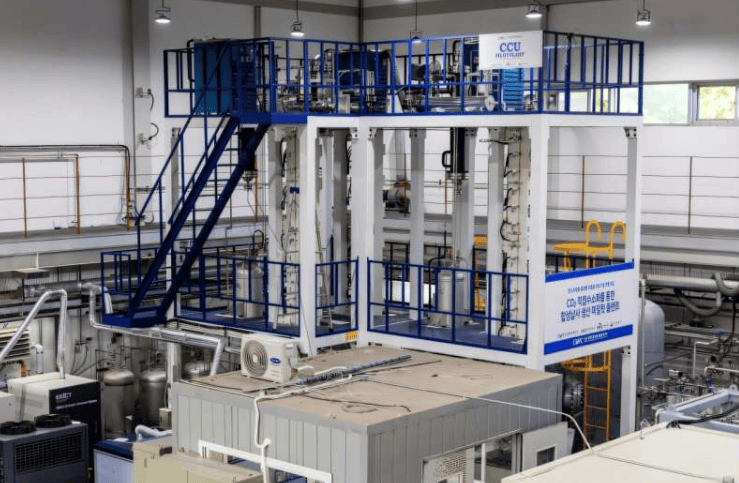
Unlike the conventional two-step method, this technology does not require first converting carbon dioxide into carbon monoxide via the reverse water-gas shift reaction at high temperatures exceeding 800 degrees Celsius. Instead, a catalyst system was developed to achieve direct conversion in a single process. The reaction operates under relatively mild conditions of approximately 270 to 330 degrees Celsius and pressures of about 10 to 30 bar. Through multi-stage reactions and recycling of unreacted feedstock, the system currently achieves a liquid hydrocarbon synthesis yield of about 50%, with a daily output roughly equivalent to three 20-liter fuel drums.
Previously, Dr. Kim's team had completed a small-scale test unit with a daily output of 5 kilograms and transferred the technology to GS Engineering & Construction and Hanwha TotalEnergies in 2022. Building on this, the joint research team established South Korea's first direct CO₂ hydrogenation pilot plant. The next step for the research team is to accumulate long-term operational data through pilot-scale optimization and demonstration, followed by commercial-scale process design for an annual output exceeding 100,000 tons, economic feasibility analysis, and greenhouse gas reduction assessment.
As geopolitical instability, such as the recent closure of the Strait of Hormuz, threatens oil and naphtha supply chains, technologies that convert industrial CO₂ emissions into valuable resources are gaining more attention. The researchers anticipate that, when combined with renewable energy, this technology could serve as a core component of power-to-liquid systems, converting renewable electricity, captured CO₂, and green hydrogen into sustainable liquid fuels.
Publication Details: Authors: Jingyu Chen et al., Title: "Cascade Conversion of CO 2 to Gasoline-Range Hydrocarbons over KFeZnO x and Zn/HZSM-5 Catalysts: The Role of Zn as an Acidity Modulator", Published in: ACS Sustainable Chemistry & Engineering (2026). Journal Information: ACS Sustainable Chemistry & Engineering