
A research team from the Korea Advanced Institute of Science and Technology (KAIST) has clearly observed the entire degradation process of the lithium anode inside lithium metal batteries at the nanoscale and identified the root cause of performance decline. This significant advancement is expected to accelerate the commercialization of lithium metal batteries. The related paper was published in the latest issue of ACS Energy Letters, a journal of the American Chemical Society.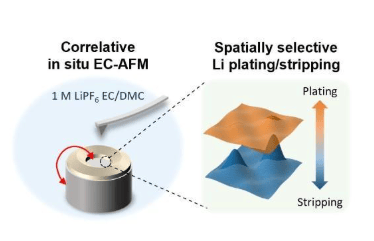
Lithium metal batteries are a new type of battery that uses metallic lithium as the anode material. Their core advantage lies in their extremely high energy density, which can theoretically reach twice that of traditional lithium-ion batteries. However, the rapid performance decay after repeated charge-discharge cycles has always been the biggest bottleneck hindering their market application. Particularly, when lithium deposits or strips in an irregular manner, it forms what is known as "dead lithium"—that portion of lithium that loses electrical connection with the electrode. This not only drags down battery performance but also poses potential safety hazards.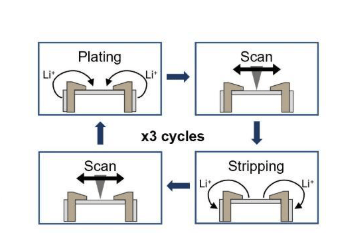
Using in-situ electrochemical atomic force microscopy, the team tracked the complete process of lithium deposition and stripping in real time, thereby confirming that the lithium reaction does not spread uniformly across the entire battery surface but occurs selectively and quietly at certain specific locations. Further observations revealed that in rough and porous weak areas on the battery surface, the stripping process easily leaves behind tiny voids. It is precisely these voids that spawn electrically isolated "dead lithium," becoming the "culprit" behind the sudden decline in battery performance.
The value of this research lies in being the first to clearly pinpoint, through experimentation, where and how lithium metal batteries are damaged. More importantly, it proves that the "initial morphology" formed by lithium in its earliest stage is a key variable determining the long-term lifespan of the battery. Based on this discovery, if the surface during lithium deposition can be uniformly and precisely regulated in the future, both battery lifespan and stability are expected to be greatly improved. This points to a design pathway that can simultaneously address the enhancement of electric vehicle range and the development of long-life batteries.