
The Shanghai Artificial Intelligence Laboratory announced on May 13 that, relying on the overall deployment of the 2030 New Generation Artificial Intelligence National Science and Technology Major Project, the Shanghai Artificial Intelligence Laboratory, in collaboration with Suzhou National Laboratory, Tsinghua University, and other partner institutions, has successfully achieved the controllable preparation of high-quality single-crystal graphite with centimeter-scale dimensions and a thickness exceeding 200 microns.
Data Foundation: Billion-Level Computational Materials Database Supports Training
According to reports, the core prerequisite for AI-assisted materials research and development is high-quality data support. To achieve the precise preparation of single-crystal graphite, the joint team constructed a billion-level computational materials database for training machine learning atomic potentials. This database significantly surpasses previous small-scale databases in data completeness, accuracy, and coverage, effectively breaking through the previous limitations of relying on small-scale open-source data or general-purpose databases, laying a solid foundation for the subsequent development of high-precision AI models.
The database focuses on the high-quality computational data required for training machine learning potentials for the nickel-carbon system, including nickel clusters of different sizes, bulk phases, surface structures, and composite configurations formed by these nickel structures with various carbon allotropes such as carbon atoms, carbon chains, carbon rings, graphene, and graphite at different temperatures. This provides both breadth and reliability for the training of high-precision machine learning potentials, and also establishes a solid foundation for the development of AI models for material surfaces and interfaces.
Algorithm Driven: Machine Learning Potential Function Model Builds an Atomic-Scale Analytical Bridge
Based on the aforementioned database, the joint team adopted the high-precision, high-efficiency NEP machine learning potential method developed by Suzhou National Laboratory, combined with the active learning workflow, uncertainty analysis algorithms, and computational materials agent framework developed by the Shanghai Artificial Intelligence Laboratory, successfully developing a machine learning potential function model, breaking through the scale and time limitations of traditional first-principles calculations.
This model can complete complex interface dynamics simulations for systems exceeding one hundred thousand atoms and millions of atomic steps, capable of capturing key microscopic mechanisms such as twin grain boundaries accelerating carbon migration, providing an atomic-scale computational bridge for understanding the macroscopic growth phenomena of high-quality single-crystal graphite.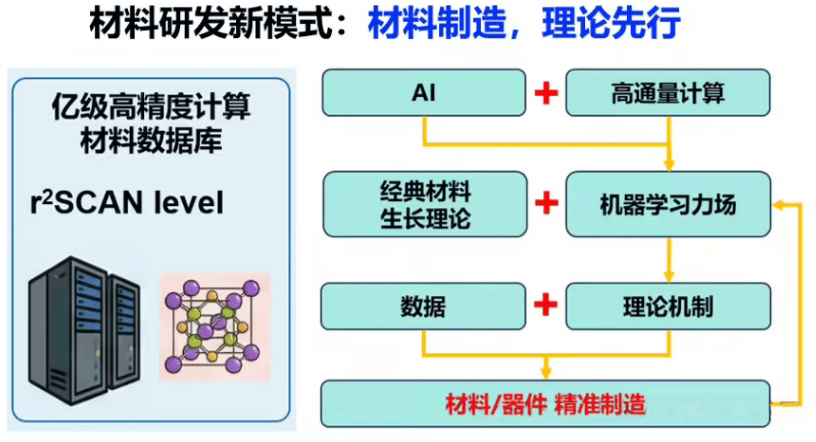
Mechanism Driven: Preparation of 200+ Micron Single-Crystal Graphite Surpasses World Record
Assisted by the high-precision machine learning potential function model, the joint team conducted large-scale, long-duration atomic-level dynamics simulations. Through simulation experiments, the team not only revealed the entire migration process of carbon atoms segregating, diffusing, nucleating, and growing within the nickel lattice, but also reproduced the entire evolutionary process of dissolution, segregation, nucleation, and epitaxial growth at the interfaces of nickel single crystals and those containing twin grain boundaries, clarifying the growth mechanism of single-crystal graphite.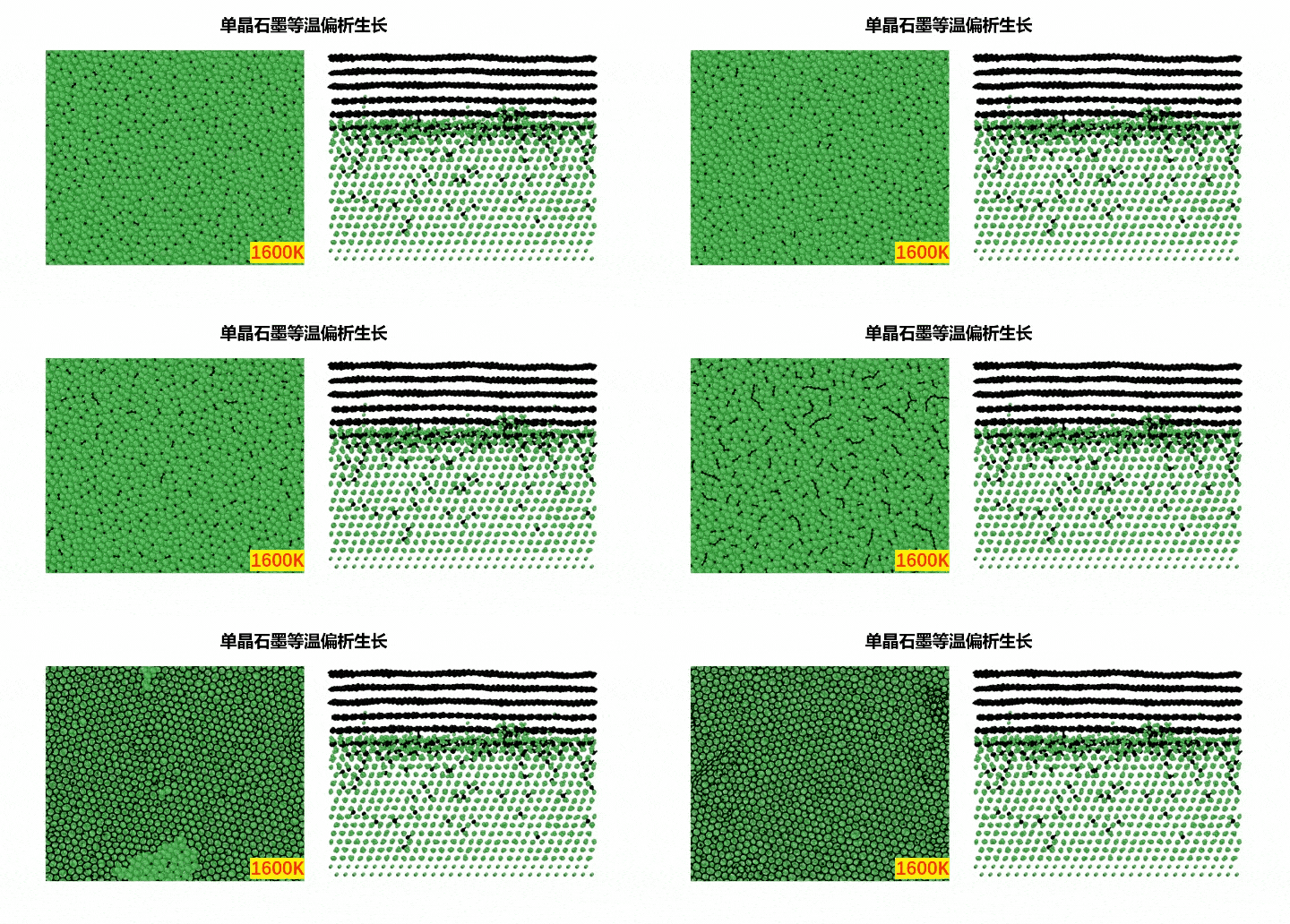
Furthermore, through quantitative simulation experiments, the joint team identified the regulatory laws governing the influence of core parameters such as reaction temperature, carbon solubility, atomic diffusion rate, and twin grain boundary structure on the growth quality of single-crystal graphite, providing quantifiable, predictable, and implementable theoretical support and computational basis for the optimization and upgrading of material preparation processes.
Based on these scientific discoveries, the joint team built a single-crystal graphite growth system and ultimately successfully prepared high-quality single-crystal graphite with centimeter-scale dimensions and a thickness exceeding 200 microns — this thickness is more than three times the current world standard. This scientific research breakthrough also explores an intelligent scientific research pathway transitioning from "trial-and-error exploration" to "mechanism-driven" approaches, validating the significant value of AI as a "revolutionary tool" driving scientific discovery.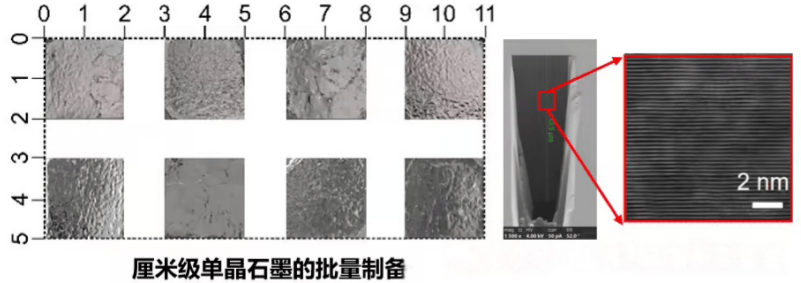
In the future, the joint team will further leverage artificial intelligence models to conduct research on experimental process parameter optimization and large-scale manufacturing, continuously advancing single-crystal graphite towards higher quality, larger areas, and more stable mass production. They will actively expand its application potential in fields such as electronic devices, thermal management, and high-end equipment, exploring the formation of a new research and development paradigm based on massive data, centered on AI models, guided by mechanistic understanding, validated by experimental preparation, and aimed at large-scale manufacturing, thereby continuously deepening and solidifying the deep integration of artificial intelligence and materials science.